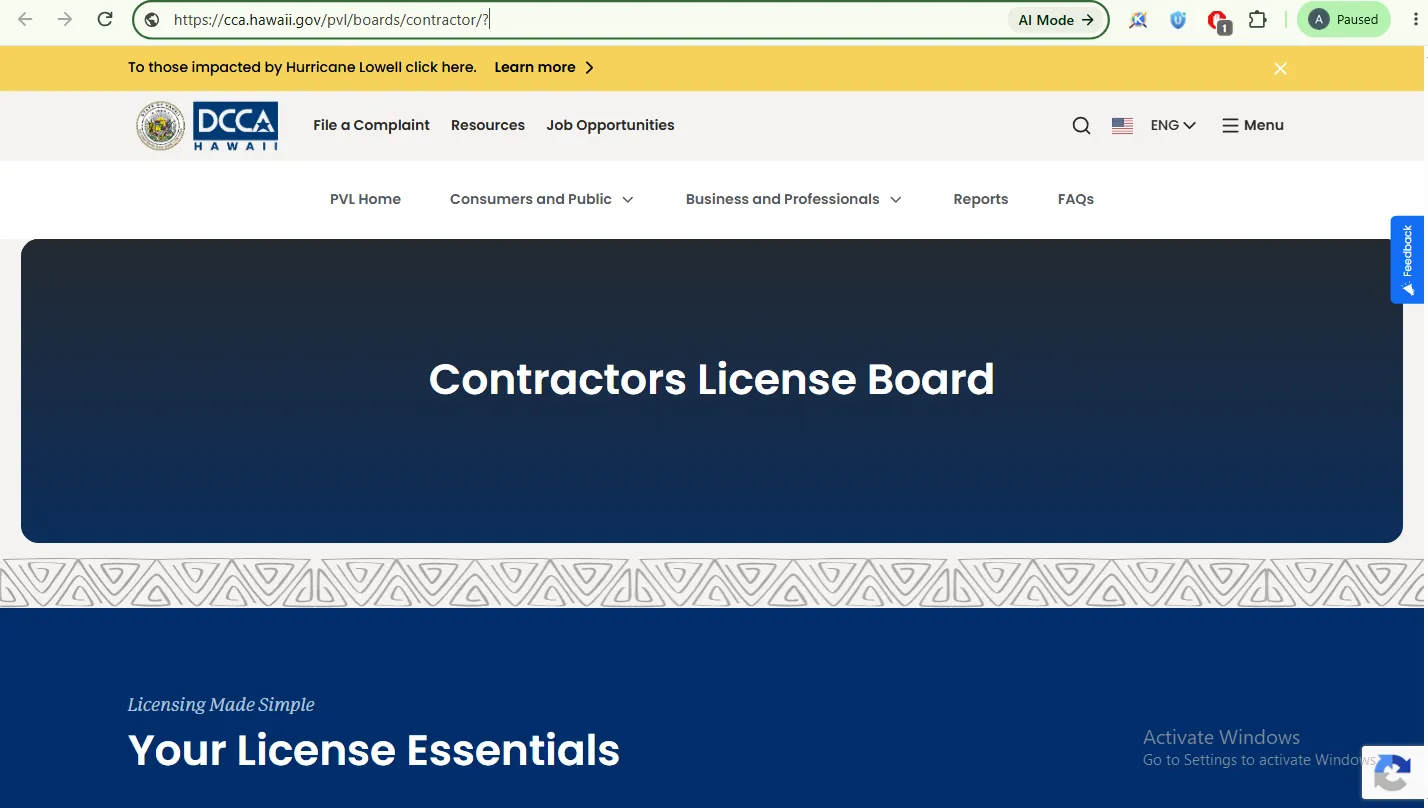
Hawaii Contractors Licensing Board 2026: License & Lookup

Hawaii Contractors Licensing Board 2026: License & Lookup is a practical Hawaii contractor license guide for homeowners, seniors, Maui rebuilding families, Oʻahu condo owners, Big Island property owners, Kauaʻi residents, subcontractors and applicants who need to verify a contractor, search a Hawaii PVL license, check BusinessCheck and RICO complaint history, understand when a contractor license is required, apply through the Contractors License Board, renew through MyPVL, or file a complaint about unlicensed contracting work.

ContractorsBoard.org — Independent Hawaii contractor lookup guide
Official Hawaii Contractors License Board
HI Hawaii contractor license help · 2026

Hawaii Contractors Board Lookup: Verify PVL License, BusinessCheck, RICO History & Renewal

In Hawaii, contractor licensing is handled by the State of Hawaiʻi Department of Commerce and Consumer Affairs, Professional and Vocational Licensing Division, Contractors License Board. Use this guide to search the public license database, confirm active status, check complaint history, understand the $1,500 license trigger, review application requirements, renew on time and avoid unlicensed contractor risk.

The most useful Hawaii contractor check is not only “is this name in a list?” A good check should compare the license number, business name, classification, RME connection, insurance, permit ability, complaint history, contract name and payment name before you sign, pay, hire, subcontract or begin work.

!

Independent guide: ContractorsBoard.org is not the official State of Hawaiʻi DCCA, PVL, Contractors License Board, RICO, BusinessCheck, MyPVL or a legal service. Always verify license status, classifications, fees, renewal dates, tax clearance, insurance, bond, RME status, complaint history, county permits and complaint rules directly with official Hawaii sources before hiring, applying, renewing, advertising, contracting or filing a claim.

Quick answer

Hawaii contractor license lookup quick answer: search PVL first, then check BusinessCheck

The official Hawaii contractor license lookup starts with the DCCA PVL public license search. You can search by contractor name, business name, individual name or license number, then review license status, original license date, expiration date and disciplinary information shown by the state database.

After the license search, use Hawaii BusinessCheck and RICO complaint history tools to see whether a business or worker has complaint history, disciplinary action, unlicensed activity legal actions or other consumer-risk signals. This two-step check is especially important for home renovations, roof work, concrete, solar-related construction, electrical work, plumbing work, condo repairs, lanai work, Maui rebuilding, storm repairs and urgent door-to-door offers.

Official-source routing

Official Hawaii sources used for this contractor board guide

This page is organized around official Hawaii DCCA and PVL routes: the Contractors License Board page, public PVL license search, BusinessCheck, RICO complaint history, license verification request, application forms, examination deadlines, MyPVL renewal, tax clearance, restoration, complaint routes and contractor hiring guidance.

PVL license search

Use for license number, status, original issue date, expiration date and state-posted discipline details.

BusinessCheck and RICO

Use for complaint history, sanctions, pending complaint clues and unlicensed activity legal actions.

Board application and renewal

Use for entity, sole proprietor, RME, application deadline, exam window, MyPVL renewal and restoration rules.

Lookup-first intent

Hawaii contractors board license search: what the lookup should answer before you hire

A Hawaii contractor board lookup should help you answer practical questions: is the license active, does the license name match the contract, is the classification right for the work, is an RME tied to the entity, can the contractor pull permits, are electricians or plumbers properly licensed, and does complaint history raise concern?

Active license

Confirm that the contractor license is active, not expired, inactive, forfeited, suspended or terminated.

Correct name

Match the PVL license name to the quote, contract, invoice, website, ad and payment request.

Right classification

Compare the license classification with the real work, such as general building, engineering or specialty work.

Complaint signals

Use BusinessCheck and RICO resources to review complaint history and unlicensed activity concerns.

Practical helper tools

Hawaii contractor lookup, application, renewal and complaint helper tools

These tools help you choose the right official Hawaii route. They do not replace DCCA, PVL, RICO, the Contractors License Board, county permit offices, legal advice, insurance review, tax clearance, bond review or current official forms.

Tool 1: Hawaii contractor route finder


Your route will appear here

Select your task. The result will point you toward the best official Hawaii DCCA route.

Tool 2: Hawaii license risk checker


Hiring risk result will appear here

Use this after opening the official PVL and BusinessCheck results.

Tool 3: License requirement checker


License requirement result will appear here

Use this before accepting a bid for remodeling, roofing, plumbing, electrical, concrete, lanai, repair or rebuilding work.

Tool 4: Applicant readiness checker


Application readiness will appear here

Use this before filing with the Hawaii Contractors License Board.

Tool 5: Complaint route finder


Complaint route will appear here

Choose the closest issue. RICO complaint, unlicensed activity report, county permit issue and Recovery Fund questions use different paths.

BusinessCheck and complaint history

Hawaii BusinessCheck and RICO complaint search: the second step after license lookup

A PVL license record tells you whether a professional license exists and what the state record shows. BusinessCheck and RICO complaint resources help you review complaint history, disciplinary action, pending complaint clues, sanctions and unlicensed activity legal actions. Use both tools before hiring, especially if the project involves a high deposit, disaster repair, roof replacement, concrete, structural work, electrical, plumbing, solar-related construction or a contractor you found through a door hanger or social media ad.

Check Why it matters Plain-English next step
PVL license status Shows whether the contractor license appears active and what license dates are posted. Do not rely on a business card; search the official database.
BusinessCheck Helps compare business registration and complaint-related information in one consumer-friendly route. Search the business name, owner name and any DBA name.
RICO complaint history Can show sanctions, disciplinary action or pending complaint signals for regulated professions. Ask the contractor to explain serious history in writing before hiring.
Unlicensed activity legal actions Unlicensed contracting can present high consumer risk and may remove important protections. If the person is unlicensed, avoid hiring and review RICO reporting options.
License required intent

When is a Hawaii contractor license required?

Hawaii DCCA’s consumer guidance says a contractor license is required for any project exceeding $1,500 in labor and material, and for any project that requires a building, electrical or plumbing permit. This makes the license question important even for jobs that look small at first, because permit requirements can trigger licensing even when the owner thinks the price is modest.

Over $1,500

If labor and materials exceed $1,500, treat the license check as required before hiring.

Permit work

If a building, electrical or plumbing permit is required, verify the contractor and the trade workers.

Electrical and plumbing

Electrical and plumbing contractors must use licensed electricians and plumbers for the actual trade work.

Senior homeowner warning: Never accept “you do not need a permit” or “I can use someone else’s license” as the final answer. Call the county permit office or verify through official Hawaii sources when the job affects structure, wiring, plumbing, roof, lanai, kitchen, bath, solar, septic, retaining wall or condo common elements.

Read the record

How to read a Hawaii contractor license search result before you trust it

A Hawaii contractor license lookup is useful only when you compare the official record with the real documents in front of you. The license name should match the written contract, quote, invoice, payment request, website, truck sign and business registration. If the contractor says “pay me personally” but the license belongs to a company, or if the company uses a different RME or classification than expected, pause and ask for written clarification.

What to check Why it matters What to do if unclear
License status Active status is a basic hiring requirement for regulated contractor work. Search again by license number and business name; call PVL if needed.
License expiration Hawaii contractor licenses renew by September 30 in even-numbered years. Ask for proof of renewal and check MyPVL/PVL status again.
Entity, sole proprietor or RME Entities often rely on an RME; the entity-RME relationship should make sense for the job. Ask who supervises the work and which license classification covers the project.
Classification The license must fit the work, such as general building, general engineering or specialty classification. Use the Contractors Board classification resources or ask PVL before hiring.
Complaints and discipline Complaint history does not always mean “do not hire,” but it is a serious due-diligence signal. Ask for a written explanation and compare with another licensed bid.
Application requirements

Hawaii contractor license application: entity, sole proprietor, RME, forms, deadline and exam

Hawaii Contractors License Board application routes include contractor entity, contractor sole owner and Responsible Managing Employee. The application packet is classification-specific and time-sensitive. The Board’s application page says the application, fee and all supporting documents must be received on or before the first Tuesday of the month two months before the scheduled board meeting date.

Application item What it means Common mistake to avoid
Entity application For corporation, LLC, partnership, joint venture, LLP or other business entity routes. Filing business, license, insurance, tax and RME information under mismatched names.
Sole owner application For a sole proprietor route where the individual license and experience documentation matter directly. Submitting incomplete project history or unclear supervisory experience proof.
RME application Responsible Managing Employee connection used by a contracting entity to qualify and supervise licensed work. Not maintaining the entity-RME relationship after license issuance.
Chronological project history Used to document supervisory experience and project background for the classification. Listing vague jobs without dates, scope, role, classification relevance or supervising duties.
Exam approval After board approval, applicants register with PSI and must pass within the allowed window. Missing the six-month exam passing window after becoming eligible.

Application timing note: DCCA says application processing is generally 45–60 business days from receipt of a completed application. Incomplete documents, name mismatches, missing support forms, tax issues or unclear experience can delay the process.

Exam and status

Hawaii contractor exam, PSI registration and application status check

After Board approval to take the examination, applicants receive an examination approval letter showing the exam they are eligible to take, how to register and the deadline by which the examination must be passed. DCCA’s contractor exam page points applicants to PSI and lists PSI telephone registration at (833) 333-4754.

Approval letter

Do not register until you have the official approval information and know which exam parts apply.

Six-month window

If the required exams are not passed within six months, the applicant may need to reapply.

Pending application

Use the public license search and select the pending-application route when checking status.

Renewal and restoration

Hawaii contractor license renewal 2026: MyPVL, tax clearance, renewal cost and restoration window

Hawaii contractor licenses are renewed by September 30 of every even-numbered year. For the October 1, 2026 to September 30, 2028 licensing period, DCCA lists renewals accepted from August 10, 2026 to September 30, 2026, with renewal by the license expiration date of September 30, 2026.

Renewal item 2026 official guidance summary Action step
Contractor entity active On-time renewal cost listed as $338.00. Renew through MyPVL and verify tax clearance name match.
Sole proprietor active On-time renewal cost listed as $338.00. Confirm license status after renewal posts.
RME active On-time renewal cost listed as $208.00. Maintain entity-RME requirements if tied to an entity.
Inactive status All contractor licenses in inactive status listed at $160.00. Do not practice as active unless status permits it.
Late restoration Forfeited licenses may be restored within 60 days after expiration if restoration requirements are met. Act quickly; failure to restore can require applying as a new applicant.

Tax clearance warning: Active contractor entities and sole proprietors must have current valid Hawaii tax clearance within six months of renewal, and the tax clearance name must match the PVL license name. Name mismatch is a common renewal problem.

Homeowner and senior-friendly checklist

Before hiring a Hawaii contractor: license, insurance, permit ability, written quote and recovery fund

Hawaii DCCA emphasizes hiring licensed contractors because licensed contractors have been checked by the Contractors License Board, should carry workers’ compensation and liability insurance, can obtain and sign building permits, and may preserve access to the Contractors Recovery Fund when the homeowner hired a currently and actively licensed contractor for qualifying residential work.

Verify before signing

  • Search the official PVL license record.
  • Search BusinessCheck and RICO complaint history.
  • Confirm the license number and business name match the written quote.
  • Ask whether the classification covers the actual work.
  • Confirm who will obtain and sign county permits.
  • Ask for liability insurance and workers’ compensation proof.
  • Save screenshots, bids, texts, receipts and job photos.

Red flags that should slow you down

  • No Hawaii contractor license number is provided.
  • The payment name is different from the licensed business.
  • The contractor says permits are not needed without checking the county.
  • Cash-only pressure, full payment up front or a very large deposit.
  • No written contract, scope, start date, change-order process or warranty terms.
  • Door-to-door disaster repair or “today only” pressure after storms or fires.
  • Electrical or plumbing work is offered without licensed electricians or plumbers.

Neighbor-island note: Oʻahu, Maui, Kauaʻi and Hawaiʻi Island projects may involve different county permit offices and inspection processes. A state contractor license does not remove county permit requirements.

County permit intent

Hawaii contractor license vs county permit: Honolulu, Maui, Kauaʻi and Hawaiʻi County routing

A Hawaii contractor license shows the state licensing status. A county permit shows whether the project has permission from the local building department. Homeowners should not treat one as a replacement for the other. A licensed contractor may still need a county permit, and permit requirements can apply to building, electrical, plumbing, structural, roof, lanai, solar, cesspool/septic and rebuilding work.

Area Practical permit reminder What to ask the contractor
City and County of Honolulu / Oʻahu Building, electrical and plumbing work often routes through Honolulu permitting systems. Who pulls the permit, who signs it, and what inspections are expected?
Maui County Rebuilding and disaster-recovery projects need careful license and permit checks. Is the contractor licensed in Hawaii, insured, permit-ready and properly classified for the scope?
Kauaʻi County Local permit and inspection rules can affect additions, remodels, plumbing and electrical work. Will you provide the permit number and inspection schedule in writing?
Hawaiʻi County / Big Island Rural, agricultural, off-grid and owner-builder situations can create extra confusion. Are permits, electrical work, plumbing work, septic/cesspool or structure rules involved?
Recovery fund intent

Hawaii Contractors Recovery Fund: why hiring a licensed contractor can matter later

Hawaii’s Contractors Recovery Fund may be available only in certain situations and only when the homeowner hired a contractor who was currently and actively licensed at the time the contract was entered into. The fund is not an instant complaint payout. It is tied to legal steps, qualifying residential work, licensing board laws or rules, judgments and limits.

License timing matters

The contractor must have been currently and actively licensed when the contract was entered into.

Private residential limits

Fund claims are generally tied to qualifying private residence, condominium or cooperative unit improvements.

Not automatic

Recovery can require court judgment, reasonable collection efforts and a formal motion process.

Legal caution: Recovery Fund, construction defect, contract dispute and repair-act issues can be legal matters. If the loss is large or deadlines are involved, speak with qualified Hawaii legal help quickly.

Complaint and unlicensed activity

Hawaii contractor complaints: RICO, unlicensed activity reports and evidence checklist

Hawaii RICO reviews complaints against professional and vocational licensees and may sue those who provide industry services without a required board-issued license. For unlicensed activity, DCCA says consumers can notify RICO at 808-587-4272 or call toll-free 1-844-808-DCCA (3222), press 3. Good evidence makes a complaint stronger.

Problem Likely route Evidence to save
Unlicensed person offering or doing contracting work Report ongoing unlicensed activity to RICO. Quote, ad, phone number, photos, vehicle details, jobsite address, payment receipts and work schedule.
You contracted with an unlicensed company or person Review the RICO Professional Licensing Complaint Form route. Contract, texts, receipts, cancelled checks, photos, license search screenshots and timeline.
Licensed contractor performed bad or unfinished work Check PVL, BusinessCheck and RICO, then review complaint and legal options. Contract, change orders, photos, inspection notes, expert repair estimates and messages.
Permit, electrical or plumbing issue Use county permit office plus PVL trade-license verification. Permit number, inspection notes, contractor license, electrician/plumber license and job photos.
Possible Recovery Fund issue Review official Recovery Fund information and legal steps. Proof contractor was active and licensed when contract was signed, plus court and collection records.

Evidence tip: Take photos before, during and after the work. Save the contractor’s ad, license number, payment request, contract, receipts, text messages, emails and jobsite dates. RICO investigations depend on clear facts.

Contact and map

Hawaii Contractors License Board phone, email, mailing address and map

For Hawaii contractor licensing, the DCCA Boards and Programs directory lists Contractor License Board mail as DCCA-PVL Att: CLB, P.O. Box 3469, Honolulu, HI 96801, and contractor email as contractor@dcca.hawaii.gov. PVL contact information lists 1-844-808-DCCA (3222), option 1, and the office location at HRH King Kalakaua Building, 335 Merchant Street, Room 301, Honolulu, Hawaiʻi 96813.

Contractor board email

contractor@dcca.hawaii.gov. Use for contractor board-specific routing and verify current contact instructions before sending documents.

PVL phone

1-844-808-DCCA (3222), option 1. Neighbor island users can also use the toll-free route listed by PVL.

Mailing address

DCCA-PVL Att: CLB, P.O. Box 3469, Honolulu, HI 96801. Confirm current filing instructions before mailing.

FAQ

Hawaii contractors board license lookup FAQs

What is the official Hawaii Contractors Licensing Board?

The official route is the State of Hawaiʻi DCCA Professional and Vocational Licensing Division, Contractors License Board. It handles contractor licensing resources, forms, renewal information, board materials and official licensing routes.

How do I look up a Hawaii contractor license?

Use the official PVL public license search. Search by contractor name, business name, individual name or license number, then confirm status, expiration date, classification and any posted discipline details.

What is Hawaii BusinessCheck used for?

BusinessCheck helps consumers review businesses and professionals, including complaint-history and licensing-related information. Use it after the PVL license search.

When is a contractor license required in Hawaii?

DCCA consumer guidance says a contractor license is required for any project exceeding $1,500 in labor and material, and for any project that requires a building, electrical or plumbing permit.

Can an unlicensed contractor do a small Hawaii project?

Do not assume a project is exempt just because it looks small. If labor and material exceed $1,500 or a building, electrical or plumbing permit is required, use the licensed-contractor route and confirm with official sources.

Do electrical and plumbing contractors need licensed workers?

Yes. Hawaii DCCA consumer guidance states electrical and plumbing contractors must employ licensed electricians and plumbers to perform the actual electrical and plumbing work.

How often do Hawaii contractor licenses renew?

Hawaii contractor licenses renew by September 30 of every even-numbered year. For the 2026 renewal cycle, DCCA lists renewals accepted from August 10, 2026 through September 30, 2026.

What is the Hawaii contractor renewal cost in 2026?

DCCA lists on-time 2026 contractor renewal costs as $338 for active contractor entity, $338 for active sole proprietor, $208 for active RME and $160 for inactive status. Verify current fees before paying.

How do I report unlicensed contractor activity in Hawaii?

Use the Hawaii RICO route. DCCA lists RICO at 808-587-4272 or toll-free 1-844-808-DCCA (3222), press 3, for unlicensed activity concerns. Save contracts, quotes, receipts, photos, vehicle details and jobsite information.

Can the Hawaii Contractors Recovery Fund help if work goes wrong?

Possibly, but it is limited and not automatic. It generally requires hiring a currently and actively licensed contractor at the time of contract, qualifying residential work, legal steps and a judgment-related process.

Final recommendation for Hawaii contractor lookup users

Start with the official PVL public license search, then check BusinessCheck and RICO complaint resources. Match the license number, business name, RME, classification, insurance proof, permit plan and payment name before signing or paying. For applicants and licensees, use official Contractors License Board forms, MyPVL renewal, tax clearance and exam deadlines instead of relying on old PDF copies or third-party summaries.