
Use the Tennessee Board, License Lookup and Monetary Limit Before You Bid or Hire
The Tennessee Board for Licensing Contractors is the state board homeowners and contractors use for general contractor licensing, home improvement licensing, Limited Licensed Electricians, Limited Licensed Plumbers, qualifying agents, renewals, complaints and disciplinary information.
For a general contractor project, the big Tennessee question is usually the project amount and scope. A contractor license is generally required before bidding, offering a price, negotiating or contracting when the total project is $25,000 or more.
Quick Answer: Tennessee Contractors Need the Right License, Classification and Monetary Limit
A Tennessee contractor license is generally required before contracting, bidding, offering to engage, or negotiating a price for projects of $25,000 or more. The license is not just a number. It has a classification that controls the type of work and a monetary limit that controls the maximum project amount.
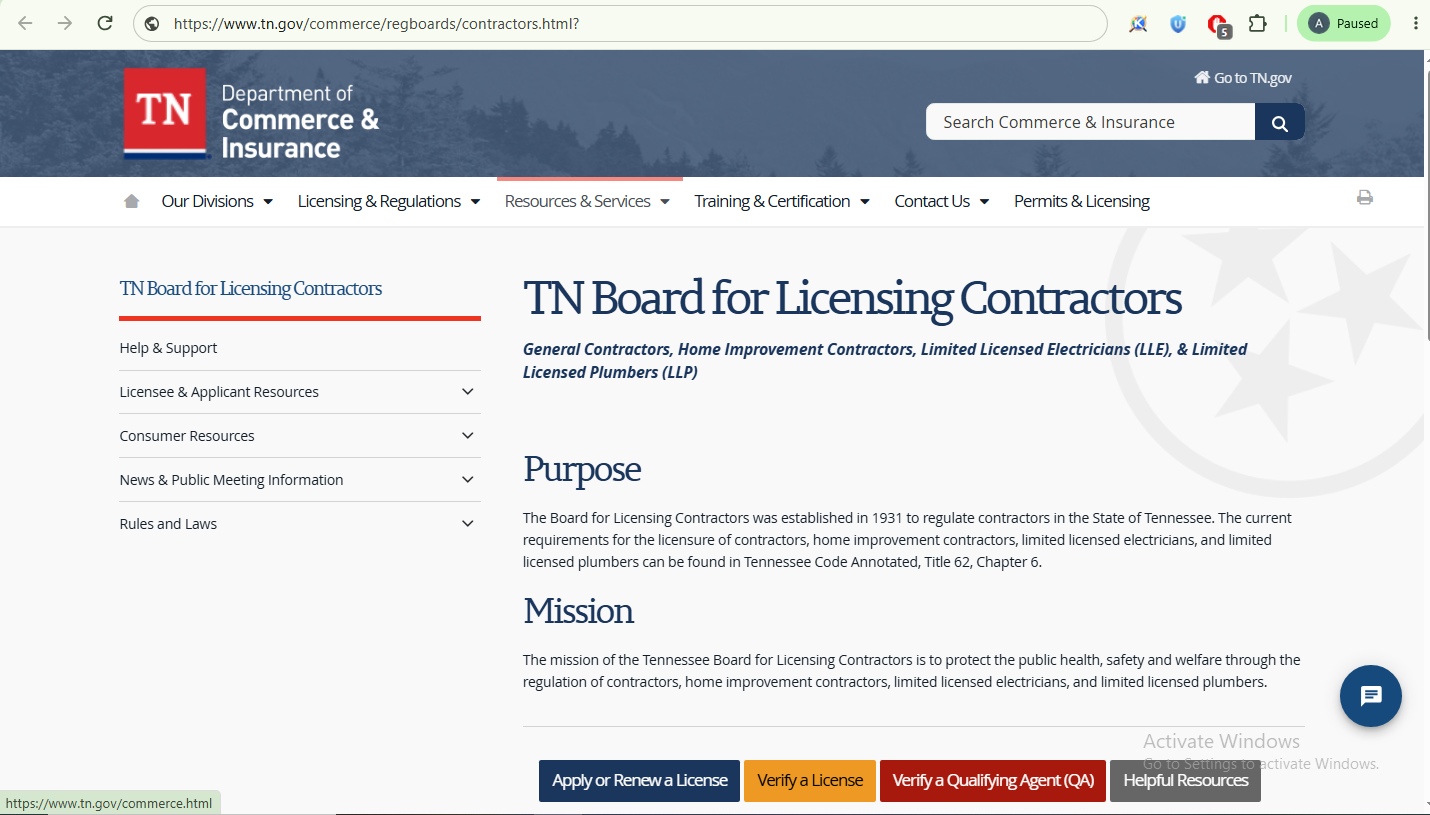
Official Tennessee Links for Lookup, Application, Renewal and Complaints
The article explains the process, but final action belongs on official Tennessee systems. Use the board page for licensing guidance, CORE for application and renewal, the public search for license verification, and the complaint page for regulatory complaints.
For homeowners checking a contractor
Use the public license search first. Then check the contractor and qualifying agent dashboard if you need more detail about the QA attached to the contractor record.
For applicants and licensees
Use the Board’s official contractor pages and CORE account for application, renewal, revisions, monetary-limit changes and document submission.
When a Tennessee General Contractor License Is Required
Tennessee requires a contractor license before the contractor contracts, bids, offers to engage, or negotiates a price when the total project is $25,000 or more. The amount includes materials, equipment and labor, so a “labor only” explanation should not be used to avoid checking the rule.
| Work relationship | Tennessee rule to check | What the reader should do |
|---|---|---|
| Prime contractor | A prime contractor bidding or contracting directly with the owner generally needs a contractor license for projects of $25,000 or more. | Verify license status, classification, monetary limit and legal business name before signing. |
| Construction manager or consultant | Construction managers and consultants are listed in the license requirement when the total project value is $25,000 or more. | Do not assume management-only work avoids the board’s licensing rule. |
| Electrical, mechanical, plumbing, HVAC or roofing subcontractor | These subcontractors generally need a contractor license when that portion of the project is $25,000 or more. | Check the subcontractor’s license and classification, not only the general contractor’s record. |
| Masonry subcontractor | Masonry subcontractors are treated differently; licensing is tied to the masonry portion reaching $100,000 or more. | Review the masonry portion amount separately and verify the LMC classification when needed. |
| Residential remodeling under $25,000 | A Home Improvement license may apply for residential remodeling from $3,000 to $24,999 in counties that adopted the law. | Check the county, project price, local permit office and home improvement license route. |
How to Verify a Tennessee Contractor License Before Hiring
A Tennessee contractor license lookup should connect the live record to the exact business asking for your money. Do not treat a screenshot, social media claim or “licensed and insured” line as proof.
Search the license number first
Ask for the license ID and search it in the official public license database. Number searches reduce confusion from DBAs, trade names and similar business names.
Match the legal business name
Compare the official record with the proposal, contract, invoice, payment name and Secretary of State business record when an entity is involved.
Check status and expiration
Confirm that the license is active and not expired, suspended or outside renewal rights before you sign, pay or allow work to start.
Read the classification
Residential, commercial, industrial, mechanical, electrical, roofing and masonry work are not interchangeable. The classification needs to fit the project.
Compare the monetary limit
The Tennessee monetary limit is tied to each individual project or contract. A license can be active and still be too small for the job.
Save the evidence
Keep the lookup result, contract, proof of payment, permit record, insurance certificate and messages in one project folder.
Tennessee Contractor Classifications and Monetary Limits
Each Tennessee contractor license is issued with both a classification and a monetary limit. The classification controls the type of work the contractor may bid and perform. The monetary limit controls the maximum authorized project amount.
BC, BC-A, BC-B, BC-C
Building classifications include residential, commercial, industrial and combined building work. BC-A is residential, BC-B is commercial, BC-C is industrial, and BC can cover the combined building path.
BC-A/r
The restricted residential limited license is for single-family residential work with a monetary limit that cannot exceed $125,000. It uses an approved course path in place of the usual exams.
CE, CMC, LMC and specialty work
Electrical, mechanical, plumbing, HVAC, fire sprinkler, roofing, masonry and specialty work can need specific classifications and trade exams.
| Classification point | How Tennessee treats it | Common mistake |
|---|---|---|
| Monetary limit | The total dollar amount for each individual project or contract, generally tied to financial strength and experience. | Thinking the limit is yearly revenue or ignoring the limit when the license is active. |
| Reviewed financial statement | Used for limits of $3,000,000 or less when following the financial-statement route. | Submitting a statement in the wrong legal name or older than the allowed window. |
| Audited financial statement | Used for limits exceeding $3,000,000 under the financial-statement route. | Requesting a high limit without the required financial support. |
| Surety bond option | Beginning July 1, 2026, the Board describes a Contractors’ Surety Bond option as an alternative to a CPA-reviewed or CPA-audited financial statement, with the bond at least 50% of the requested monetary limit. | Using a non-board format bond or assuming any insurance bond qualifies. |
How to Apply for a Tennessee General Contractor License
A Tennessee contractor application is more than one form. Most applicants need the right classification, exam plan, qualifying agent, financial documentation, insurance proof, workers’ compensation proof or exemption, reference, affidavit, business registration and fee.
| Application item | What to prepare | Delay to avoid |
|---|---|---|
| Qualifying Agent | The QA is the person designated to take the exams for the entity. The QA may be an owner, officer or full-time employee. | Using a QA without the required relationship or missing Power of Attorney when needed. |
| Exams | Business and Law is required for contractor applicants. A trade exam is required for certain classifications. | Taking only a trade exam and forgetting the Business and Law requirement. |
| Financial support | Use the current financial-statement or approved surety-bond path that fits the requested monetary limit. | Submitting documents that do not support the requested limit. |
| Insurance | General liability insurance is required based on the monetary limit. Workers’ compensation is required unless proof of exemption is provided. | Submitting a certificate that does not list Tennessee coverage or the correct certificate holder. |
| Reference and affidavit | A letter of reference from a past client, employer or code official, plus a properly completed contractor affidavit. | Using a family member as the reference or submitting an unsigned/notarization-defective affidavit. |
| Business registration | Corporations, LLCs and other entities may need Tennessee Secretary of State proof or foreign registration. | Applying under a name that does not match the business record. |
Exam, Prov Transition, NASCLA and Reciprocity Notes
Beginning July 1, 2026, Prov serves as the Board’s new exam provider for contractor exams administered after that date. PSI may still handle appointments that were already scheduled during the transition period. New applicants should follow the current Board and Prov instructions, not an old PSI-only guide.
Business and Law
All new Tennessee contractor applicants must pass the Business and Law exam unless a specific approved exception applies. The same person taking Business and Law does not have to be the same person taking the trade exam.
Trade exam
Trade exams depend on the requested classification. Plumbing CMC-A and full mechanical CMC require Board pre-approval, and the Board lists a $50 fee for that request.
NASCLA
Tennessee accepts the NASCLA National Commercial exam, but NASCLA is not a Tennessee license. You still must apply to Tennessee and meet Tennessee requirements.
Trade exam waivers
Tennessee has trade exam waiver agreements with several boards in other states. These are trade-exam waivers only, not permission to work in Tennessee without a Tennessee license.
Tennessee Home Improvement Contractor License: $3,000 to $24,999 in Certain Counties
A Tennessee Home Improvement license is different from the full contractor license. It may apply to residential remodeling projects from $3,000 to $24,999, but only in counties that adopted the law.
Under $3,000
The home improvement license route may not apply, but local permits, trade licenses, insurance checks and written-contract caution can still matter.
$3,000 to $24,999
Check whether the county adopted the home improvement law and whether the project is residential remodeling covered by that route.
$25,000 or more
Move to the full contractor license analysis. Verify classification, monetary limit, insurance, workers’ compensation and local permits.
Tennessee Contractor License Renewal, Retirement and Residential RCE
Tennessee contractor license renewal is handled through CORE when available in the licensee account. The Board’s renewal guidance says renewal appears within 90 days of expiration and recommends filing at least 30 days before expiration.
| Renewal issue | Current Tennessee point | Action to take |
|---|---|---|
| Renewal fee | Contractor renewal is listed as $200. | Confirm the fee page and pay through the official route. |
| Late renewal | The contractor grace period is 12 months with a $20 per month late fee. | Do not continue contracting on an expired license while waiting. |
| Residential RCE | Residential classifications BC-A, BC-A/r and BC-A,b(sm), when subject to the rule, require eight hours of Board-approved Residential Continuing Education. | Attach proof during renewal as instructed by the Board. |
| Retirement | A license not being used for contracting may be placed in retirement if eligible. | Use the official retirement form and do not advertise or contract as active while retired. |
Local Tennessee Permits Still Matter After the State License Check
A Tennessee contractor license is not the same thing as a local building permit. The state board license may allow the contractor to contract within the classification and monetary limit, but the city or county codes office controls project-specific permits and inspections.
Homeowner permit check
- Ask who is pulling the permit.
- Match the permit applicant to the licensed contractor when required.
- Confirm the permit type matches the scope.
- Keep inspection approvals with the project file.
Contractor local check
- Check the city or county business tax/license requirement.
- Confirm permit submittal rules before bidding.
- Verify trade permit and inspection rules.
- Do not treat state licensing as a zoning approval.
Tennessee Contractor Complaints, Discipline and Money-Back Expectations
Consumers may file complaints with the Tennessee Department of Commerce & Insurance when they believe there is unlicensed activity, misconduct, unfair or deceptive business practice, or another possible violation. The complaint process is regulatory; it is not the same as a private lawsuit, repair order or guaranteed refund.
| Problem | Best Tennessee route | Evidence to collect |
|---|---|---|
| No license or false license claim | Verify the record, save the ad or contract, then use the official complaint route if needed. | License claim, estimate, invoice, photos, messages, business card and payment proof. |
| Work outside classification or monetary limit | Compare classification and monetary limit to the full project amount and scope. | Lookup screenshot, written scope, change orders, permit valuation and total contract value. |
| Abandoned or unsafe work | Contact the local codes office for safety or permit issues and review the Board complaint route. | Photos, inspection notices, permit records, timeline, payments and communications. |
| Refund or repair dispute | Keep evidence, file a regulatory complaint where appropriate and consider private legal advice for money recovery. | Contract, proof of loss, messages, payment records, expert notes and inspection reports. |
Tennessee Board for Licensing Contractors Contact Details
Use the official board contact route for licensing questions, application issues, renewal questions and complaint guidance. Verify current instructions before mailing forms or visiting a state office.
Board for Licensing Contractors
Useful Tennessee checks
Related ContractorsBoard.org Guides
Tennessee contractor license lookup
Use this when your main goal is checking a live contractor record, classification, monetary limit and qualifying agent before hiring.
Open Tennessee license lookup guideTennessee Board for Licensing Contractors
Use this broader board guide for contractor, home improvement, LLE, LLP, complaint, renewal and board-resource routing.
Open Tennessee board guideContractor license check
Use this national checklist to compare license status, legal name, insurance, permit responsibility and contract red flags.
Open contractor license check guideTennessee Board for Licensing General Contractors FAQs
Who regulates Tennessee general contractor licenses?
The Tennessee Board for Licensing Contractors under the Tennessee Department of Commerce & Insurance regulates contractors, home improvement contractors, Limited Licensed Electricians and Limited Licensed Plumbers.
When is a Tennessee contractor license required?
A Tennessee contractor license is generally required before bidding, offering a price, negotiating or contracting for projects of $25,000 or more. Certain subcontractors also need a license when their portion reaches the applicable threshold.
How do I verify a Tennessee contractor license?
Use the official Tennessee public license search. Check the license status, expiration, legal business name, classification, monetary limit and qualifying agent information where available.
Does an active license mean the contractor can take any job?
No. The license must have the right classification and monetary limit for the project. A contractor can have an active license but still be outside the proper scope or limit.
What is the Tennessee contractor monetary limit?
The monetary limit is the maximum amount the contractor may contract for on each individual project or contract. It is tied to financial strength and experience, and it appears with the license classification.
What changed with Tennessee contractor exams in 2026?
Beginning July 1, 2026, Prov serves as the Board’s exam provider for new contractor exam scheduling. Older PSI-only guidance should be checked against the current Board instructions.
Does Tennessee accept NASCLA?
Tennessee accepts the NASCLA National Commercial exam, but NASCLA is not a Tennessee license. Contractors must still apply to Tennessee and meet state requirements.
What is the Tennessee BC-A/r license?
BC-A/r is the restricted residential limited license for single-family residential work with a monetary limit that cannot exceed $125,000. It uses an approved course path and has no 10% monetary-limit tolerance.
Do Tennessee residential contractors need continuing education?
Residential classifications such as BC-A, BC-A/r and BC-A,b(sm), when subject to the rule, need eight hours of Board-approved Residential Continuing Education for renewal.
Can a Tennessee complaint get my money back automatically?
No. A Tennessee contractor complaint is a regulatory route. It may address licensing or misconduct issues, but private money recovery, repair disputes or legal enforcement may require separate action.
Final Tennessee Contractor Check
Before you hire, bid or renew, match the Tennessee license status, legal business name, classification, monetary limit, qualifying agent, insurance, workers’ compensation status and local permit route. The safest Tennessee contractor file is official, current and documented.