
Verify the License, Class and Permit
Georgia licenses individual electrical contractors through the State Construction Industry Licensing Board’s Electrical Contractors Division. The public GOALS search helps users confirm the responsible person, license class and current status.
Applicants and licensees can use this guide to document experience, prepare references, understand exam approval, report CE through CE Broker and avoid outdated reciprocity, renewal and exam-reference information.
Georgia Electrical Contractor License: Fast Answer
Search the licensed individual in the official GOALS Professional Licensee Search. Georgia’s Board licenses electrical contractors—not electrical companies and not each electrician or employee working under the contractor.
Current 2026 Renewal Alert
The live Board page lists license expiration on June 30, 2026 and a late-renewal period from July 1 through August 15, 2026. An older how-to page still says July 31, so use the live Board notice and the deadline displayed inside GOALS.
Georgia Electrical Contractor License Lookup
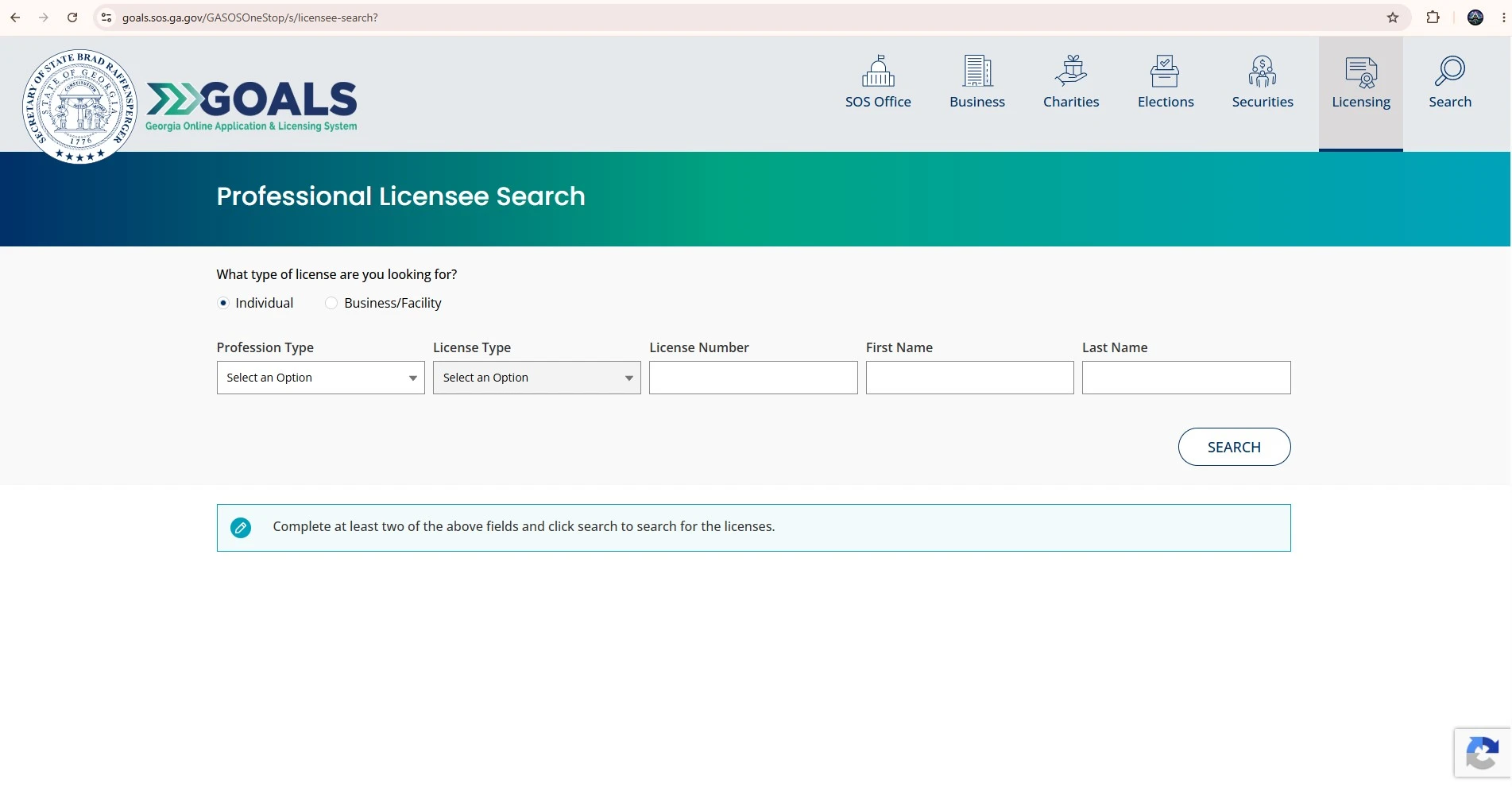
The GOALS Professional Licensee Search accepts profession type, license type, license number, first name and last name. The current search screen instructs users to complete at least two fields.
Official Georgia license-search preview
The screenshot below shows the official GOALS search form. Use the individual search route and identify the actual electrical contractor responsible for the project rather than searching only the company’s advertising name.
Exact lookup sequence
Ask for the responsible license holder
Request the full legal name, license number and class of the individual electrical contractor responsible for supervising or contracting the work.
Select the individual search
The Board does not register electrical contracting companies. Do not select Business/Facility merely because the project is being sold under a company name.
Choose Electrical Contractors
Select the electrical-contractor profession and the relevant license type when the GOALS search offers those filters.
Complete at least two fields
A strong combination is license number plus last name. When the number is unavailable, use the licensed person’s first and last names.
Match the class and status
Compare the live status and Class I or Class II designation with the service phase, amperage and actual project scope.
Save and recheck the result
Keep a dated screenshot or printout. Recheck if the project is delayed, the license is close to expiration or another person appears on the permit.
How to Read a Georgia Electrical License Result
A matching name is not enough. The status, license class, expiration and responsible individual must all fit the project.
| Result field | What it means | What to compare | When to pause |
|---|---|---|---|
| Active | The license currently appears available for licensed practice. | Check again before work begins or a major payment is released. | The contractor presents an old pocket card instead of the live record. |
| Active-Renewal Pending | The official status explainer says a timely renewal is under review and the license is not considered lapsed while that status remains. | Confirm that the live record actually displays this exact status. | The person only says a renewal is pending but the record shows expired or lapsed. |
| Lapsed, expired or suspended | The person should not be treated as holding a normal active license. | Ask what renewal or reinstatement route is being used. | Licensed work is scheduled before the status becomes valid. |
| Class I Restricted | Single-phase installations not exceeding 200 amperes at the service drop or service lateral. | Confirm the project’s phase and service size. | The project involves three-phase power or more than 200 amperes. |
| Class II Non-Restricted | Unrestricted statewide electrical-contractor classification. | Still verify permit, inspection and company identity. | The person named in GOALS is not connected clearly to the contracting company. |
| Expiration date | Shows when renewal is due. | Make sure the license will remain valid when work occurs. | The project begins after expiration without a valid pending or renewed status. |
When no record appears
- Confirm that “Individual” is selected.
- Check the licensed person’s legal spelling.
- Use license number plus last name.
- Remove unnecessary spaces or punctuation from the number.
- Check whether the work belongs to the Low Voltage Contractors Board.
- Ask for a current license copy and compare every digit.
- Contact the Board before accepting “the portal has not updated” as an explanation.
Tool 1: Electrical License Match Checker
Complete this only after opening the official GOALS record. It organizes risk signals and does not replace state or local review.
Georgia Class I vs Class II Electrical Contractor License
Class I is not simply a residential license, and Class II is not merely a commercial label. The legal distinction focuses on phase, service amperage and scope.
| License class | Official scope | Typical warning signs | Applicant evidence |
|---|---|---|---|
| Class I Restricted | Single-phase electrical installations not exceeding 200 amperes at the service drop or service lateral. | Three-phase systems, services above 200 amperes or unclear service details. | Experience in at least five listed work categories plus load calculations. |
| Class II Non-Restricted | Unrestricted statewide electrical contracting. | Local permits and inspections still apply despite unrestricted state scope. | Experience in all listed work categories and installations exceeding the Class I limit. |
Projects that should trigger Class II review
- Three-phase electrical service.
- Service capacity above 200 amperes.
- Industrial or manufacturing installations.
- Large commercial distribution systems.
- Projects with complex motors, generators or switchgear.
- Any project where phase or service size cannot be confirmed.
Tool 2: Class I or Class II Project Clue
This is a planning clue only. The contractor, designer, Board and local permit authority determine the legally appropriate credential and project requirements.
Individual License vs Electrical Contracting Company
The Board licenses the individual electrical contractor. The company selling the project may separately be an LLC, corporation, partnership or trade name.
Verify the person
- Full legal name in GOALS.
- License number and class.
- Current status and expiration.
- Connection to the company and project.
- Person identified on permit paperwork where required.
Verify the company
- Exact legal or registered trade name.
- Active Georgia business-entity record where applicable.
- Matching insurance certificate.
- Matching bid, contract and invoice names.
- Matching payment recipient.
Before Hiring a Georgia Electrical Contractor
Electrical work is life-safety work. Verify the license, company, insurance, permit route and written scope before releasing a substantial payment.
Verify before signing
- Active individual electrical-contractor license.
- Correct Class I or Class II scope.
- Active company record where applicable.
- Insurance certificate obtained from the agent.
- Local electrical permit responsibility.
- Inspection and utility-release plan.
Slow down when
- The company refuses to identify its licensed contractor.
- The number belongs to another person or profession.
- A Class I holder proposes three-phase or over-200-amp work.
- The contractor asks the owner to hide who performed the work.
- No permit will be obtained for permit-required work.
- Full payment is demanded before inspection or completion.
Put these details in the contract
| Contract item | Question it should answer |
|---|---|
| Licensed contractor | Which individual Georgia license holder is responsible? |
| Electrical scope | Which panels, circuits, feeders, equipment and repairs are included? |
| Service details | What phase and amperage are involved? |
| Permit and inspections | Who obtains the permit and schedules rough, service and final inspections? |
| Utility coordination | Who arranges disconnect, reconnect, meter and service release? |
| Payment stages | Which completed or inspected milestone triggers each payment? |
| Changes | Must extra cost or time be approved in writing first? |
Electrical Contractor, Low Voltage and Other Georgia Routes
Georgia uses separate licensing divisions for electrical, low voltage, conditioned air, plumbing and general construction.
| Work type | Likely state route | Common mistake |
|---|---|---|
| Services, panels, feeders and branch circuits | Electrical Contractors Board, Class I or Class II | Using a low-voltage credential for line-voltage work. |
| Alarm systems | Low Voltage Alarm or appropriate low-voltage class | Assuming a general electrical license answers every alarm-licensing question. |
| Telecommunications and data cabling | Low Voltage Telecommunications or other applicable low-voltage class | Ignoring fire, building or local permit rules. |
| HVAC equipment and controls | Conditioned Air plus electrical or low-voltage credentials where applicable | Treating one contractor license as authority for every trade. |
| General building construction | Residential and Commercial General Contractors Board | Assuming a general contractor license authorizes electrical contracting. |
How to Apply for a Georgia Electrical Contractor License
Georgia no longer accepts paper electrical-contractor applications. Prepare the required documents first, then submit the correct online application through GOALS.
Choose Class I or Class II
Class I is restricted to qualifying single-phase installations up to 200 amperes. Class II applicants must document experience beyond that restriction.
Confirm the minimum age
A statewide Class I or Class II applicant must be at least 21 years old.
Build a four-year experience timeline
Document employers, supervisors, dates, hours, duties, system sizes and direct installation work covered by the Georgia Electrical Code or National Electrical Code.
Prepare three references
Use the required reference process. At least one reference must be a licensed electrical contractor who includes the license number.
Obtain a local background check
The current checklist calls for a background check from a local law-enforcement agency. Prepare court records and a written explanation when disciplinary or criminal-history answers require support.
Prepare identity and citizenship documents
Upload the secure and verifiable document, citizenship affidavit and applicable immigration documents.
Submit the application and current fee
The current how-to guide lists a $110 fee for new Restricted and Non-Restricted examination applications. Confirm the amount displayed in GOALS before paying.
Wait for Board approval before PSI
The Board must approve the application before the applicant registers for the examination. Follow the Exam Approval Letter rather than an exam-prep company’s scheduling instructions.
Application timing and deficiency rules
| Stage | Current official guidance | Applicant action |
|---|---|---|
| Initial processing | Generally about 20 business days, depending on circumstances and volume. | Check GOALS rather than sending duplicate submissions. |
| Deficiency response | The processing count restarts when corrected and complete documentation is received. | Answer every item in one organized response. |
| Unresolved deficiency | An incomplete application may be withdrawn after 60 days. | Do not let a request sit unanswered. |
| Board agenda | The file generally must be complete at least 15 days before the meeting. | Plan references and missing documents well before the desired meeting. |
How to Document Qualifying Electrical Experience
Vague job titles are weak evidence. Organize work by the exact technical categories listed in Georgia Rule 121-3.
| Experience category | Useful details to record |
|---|---|
| Raceway systems | Conduit type, size, pull boxes, junction boxes, cabinets and installation responsibilities. |
| Conductors and terminations | Conductor sizing, ampacity, splices, taps, terminations, overcurrent protection and metering. |
| Services and grounding | Service entrances, meters, disconnects, grounding electrodes, bonding and ground-fault protection. |
| Motors and generators | Horsepower, feeders, controllers, disconnects and protective devices. |
| Controls and utilization equipment | Lighting controls, appliances, HVAC controls, branch circuits and disconnects. |
| Special occupancies | Applicable NEC Chapter 5 occupancy type and work performed. |
| Grounding and bonding | Equipment grounding conductors, metal piping bonds and non-current-carrying metal parts. |
| Load calculations | Lighting loads, branch circuits, feeders, conductor fill, demand factors and derating calculations. |
Secondary experience and education
The rule allows limited credit for qualifying education, inspection, engineering, project management and related secondary experience. Explain the dates, curriculum, responsibilities and direct connection to electrical contracting rather than submitting only a diploma or job title.
Tool 3: Application Readiness Checker
Select every item already prepared. The result identifies gaps but does not determine Board eligibility.
Georgia Electrical Contractor Exam and PSI Process
Applicants do not begin by booking PSI independently. The Board first decides whether the application qualifies for examination.
Board approval first
The Board can approve testing, request more information or deny the application.
Approval valid one year
The Exam Approval Letter contains PSI registration instructions and remains valid for one year.
After two failures
A Board-approved review course must be completed before a third examination attempt.
Do not use the expired 2025 reference list as a current list
The electrical-contractor reference-list PDF currently indexed by search engines states that it applied only through December 31, 2025. Do not buy expensive books from that list without confirming the current 2026 instructions in the Board approval letter or PSI program materials.
- Wait for the official Exam Approval Letter.
- Confirm the approved Class I or Class II examination.
- Use the current PSI scheduling and identification instructions.
- Confirm the permitted book editions and annotation rules.
- Request ADA accommodation before scheduling where needed.
- Keep the approval letter accessible on test day.
Georgia Electrical Reciprocity Changed in 2026
The current Board FAQ states that Georgia does not presently offer electrical-contractor licensure by reciprocity, effective May 2026.
Out-of-state applicant checklist
- Provide the current out-of-state license number and issuing board.
- Ask whether a Georgia examination application is now required.
- Confirm whether experience and references must be resubmitted.
- Do not assume a company license transfers to an individual Georgia license.
- Keep written Board confirmation of the correct route.
Georgia Electrical Contractor Renewal and CE Broker
Electrical-contractor licenses renew in even-numbered years. Continuing education must be completed before renewal and documented through CE Broker for the 2026 cycle.
| Renewal item | Current requirement | Mistake to avoid |
|---|---|---|
| Normal deadline | June 30 of even-numbered years | Waiting for an email reminder. |
| 2026 late period | Live Board page lists July 1 through August 15, 2026 | Following the older July 31 date without checking GOALS. |
| Continuing education | Four approved hours per year, normally eight per two-year cycle | Finishing CE after submitting renewal. |
| CE Broker | Report qualifying CE and certificates for education completed from January 1, 2026 onward | Assuming every provider uploaded the certificate. |
| Record retention | Keep supporting CE documentation for at least five years | Discarding certificates after renewal approval. |
| Newly licensed | One year or less before initial renewal generally requires no CE; more than one but less than two generally requires four hours | Using the full eight-hour rule without checking the initial-license date. |
2026 renewal workflow
- Create or open the CE Broker account.
- Confirm all required activities and certificates are visible.
- Resolve missing or rejected CE before starting renewal.
- Update email, mailing address and physical address.
- Answer criminal and disciplinary questions accurately.
- Submit renewal through GOALS and save the confirmation.
- Check the public record until the status is updated.
Expired or Lapsed Electrical Contractor License
The reinstatement route changes after three years. Do not resume electrical contracting until the public license record shows a valid status.
Lapsed less than three years
Use the current GOALS reinstatement route and prepare CE, background, identity, citizenship and disciplinary documents requested for the transaction.
Lapsed three years or more
The official how-to guide states that examination is required before the reinstated license is issued. Experience and reference documents may also be requested.
Do not trust old paper reinstatement fees or addresses
Older PDFs still indexed online contain previous fees, paper instructions and the former Coliseum Drive address. Use the current GOALS fee schedule and the current Professional Licensing Boards Division address.
- Confirm the original license class and expiration date.
- Select reinstatement rather than a new application unless directed.
- Complete required CE and upload certificates.
- Obtain the current background check.
- Prepare court or disciplinary records where applicable.
- Confirm whether re-examination is required.
- Check the current fee inside GOALS before paying.
- Verify active status before contracting again.
Georgia Electrical Permits and the 2026 Electrical Code
A state electrical-contractor license does not replace the permit, inspection or utility-release process for a specific property.
Current Georgia state minimum electrical code
Georgia’s Department of Community Affairs currently lists the 2023 National Electrical Code with Georgia’s 2026 amendments. The amendment packet is revised January 1, 2026 and forms part of the official Georgia State Minimum Standard Electrical Code.
Permit questions to ask locally
- Does this exact work require an electrical permit?
- Must the licensed contractor submit the permit personally?
- Which license number must appear on the application?
- Are load calculations or drawings required?
- Which rough, service and final inspections apply?
- Who requests utility disconnect and reconnect?
- What is required for service release or occupancy approval?
Local jurisdiction tip
An Atlanta, Savannah, Augusta, Macon or other city mailing address does not always identify the correct permit authority. Confirm whether the project is inside city limits or in an unincorporated county area.
Georgia Electrical Contractor Complaints and Unlicensed Work
A licensing complaint, permit complaint, insurance claim and private contract dispute are different processes.
| Problem | Starting route | Evidence to preserve |
|---|---|---|
| Unlicensed electrical contracting | Georgia Professional Licensing complaint process | Advertisement, bid, claimed number, project address, photos and messages. |
| License-class mismatch | Electrical Contractors Board complaint | GOALS record, service phase, amperage, plans, bid and permit. |
| Unsafe or unpermitted work | City or county inspection department | Address, photographs, permit search and inspection notice. |
| Deposit or unfinished-work dispute | Written demand, consumer help, insurance or legal route depending on facts | Contract, payments, change orders, messages and repair estimates. |
| Property damage or injury | Emergency services, insurer and qualified legal advice | Photographs, reports, witnesses, invoices and policy information. |
What the licensing complaint process can do
- Determine whether the issue falls within the Board’s jurisdiction.
- Investigate licensed or unlicensed practice allegations.
- Close a matter for insufficient evidence.
- Issue public or private disciplinary outcomes where authorized.
- Post public actions to the professional record when applicable.
What it does not guarantee
A licensing complaint does not guarantee a refund, repair, insurance payment or civil judgment. Preserve contractual, limitation, lien and insurance deadlines separately.
Complaint evidence packet
- Licensed person’s full name and license number.
- Company’s exact legal and advertising names.
- Estimate, contract and change orders.
- Permit and inspection documents.
- Phase, amperage or service information where class is disputed.
- Dated photos and video.
- Payment records and invoices.
- Written correction requests and replies.
- A clear chronological timeline.
Georgia Electrical Contractors Board Contact Help
Use the official contact form for application-specific questions and include the GOALS application or license number.
Licensing phone
Have the license or application number ready.
Current office
3920 Arkwright Rd
Suite 195
Macon, GA 31210
Older PDFs may still show the former Coliseum Drive address.
Online contact form
The form accepts applicant details, license or application number, a written question and supporting PDF or image attachments.
Georgia Electrical Contractor License FAQs
How do I verify a Georgia electrical contractor license?
Use the official GOALS Professional Licensee Search. Select the individual search, choose the Electrical Contractors profession, complete at least two search fields and compare the name, license number, class, status and expiration with the project paperwork.
Does Georgia license electrical companies or individual contractors?
The Georgia Electrical Contractors Board licenses individual electrical contractors. It does not register electrical contracting companies and does not issue a state license to every electrician or employee.
What is a Georgia Class I electrical contractor license?
Class I is restricted to single-phase electrical installations that do not exceed 200 amperes at the service drop or service lateral.
What is a Georgia Class II electrical contractor license?
Class II is an unrestricted statewide electrical-contractor license. Class II applicants must document experience beyond the Class I single-phase 200-amp limitation.
How much is the Georgia electrical contractor application fee?
The current official how-to guide lists a $110 fee for initial Restricted and Non-Restricted examination applications. Confirm the amount displayed in GOALS before paying.
How much experience is required?
Applicants generally must document at least four years of qualifying primary electrical experience. Limited secondary experience or education may receive credit under the Board’s rules.
What score is required on the electrical contractor exam?
Georgia Rule 121-3 requires a minimum score of 70 on the appropriate examination. The Board must approve the application before PSI registration.
When is the 2026 electrical contractor renewal deadline?
The normal deadline was June 30, 2026. The current Board page lists the 2026 late-renewal period from July 1 through August 15, although an older how-to page still displays July 31.
How many continuing-education hours are required?
Georgia requires four approved continuing-education hours per year, normally eight hours during the two-year renewal cycle. Education completed for the 2026 process must be reported through CE Broker, subject to initial-license exceptions.
Does Georgia currently offer electrical contractor reciprocity?
The current Board FAQ says Georgia does not presently offer electrical-contractor licensure by reciprocity, effective May 2026. Out-of-state applicants should confirm the required examination route with the Board.
Match the Person, Class, Company and Permit
Property owners: verify the individual license holder, confirm the class fits the project, check the company identity and require the correct electrical permit before work begins.
Applicants and licensees: use GOALS, document technical experience carefully, answer deficiencies promptly, report CE before renewal and rely on the current Board notice rather than outdated PDFs.