
Check the License Before the Contract
Use the official North Carolina Licensing Board for General Contractors record to confirm the exact licensee, qualifier, classification, project limitation and current status before signing, paying or issuing a permit.
Applicants can also use this guide to choose the correct license level, prepare financial and background documents, understand the examination route, renew on time and avoid preventable application delays.
Use the Current $40,000 Threshold
Older guides may still say $30,000. Under the current 2026 rules, a North Carolina general contractor license is required for a covered construction contract or undertaking valued at $40,000 or more. Do not divide connected work into smaller contracts merely to avoid the threshold.
Verify an NC General Contractor License
Search the exact individual, corporation, LLC or partnership that will sign the contract and receive payment. A qualifier’s examination credential does not give an unlicensed company permission to borrow that person’s license.
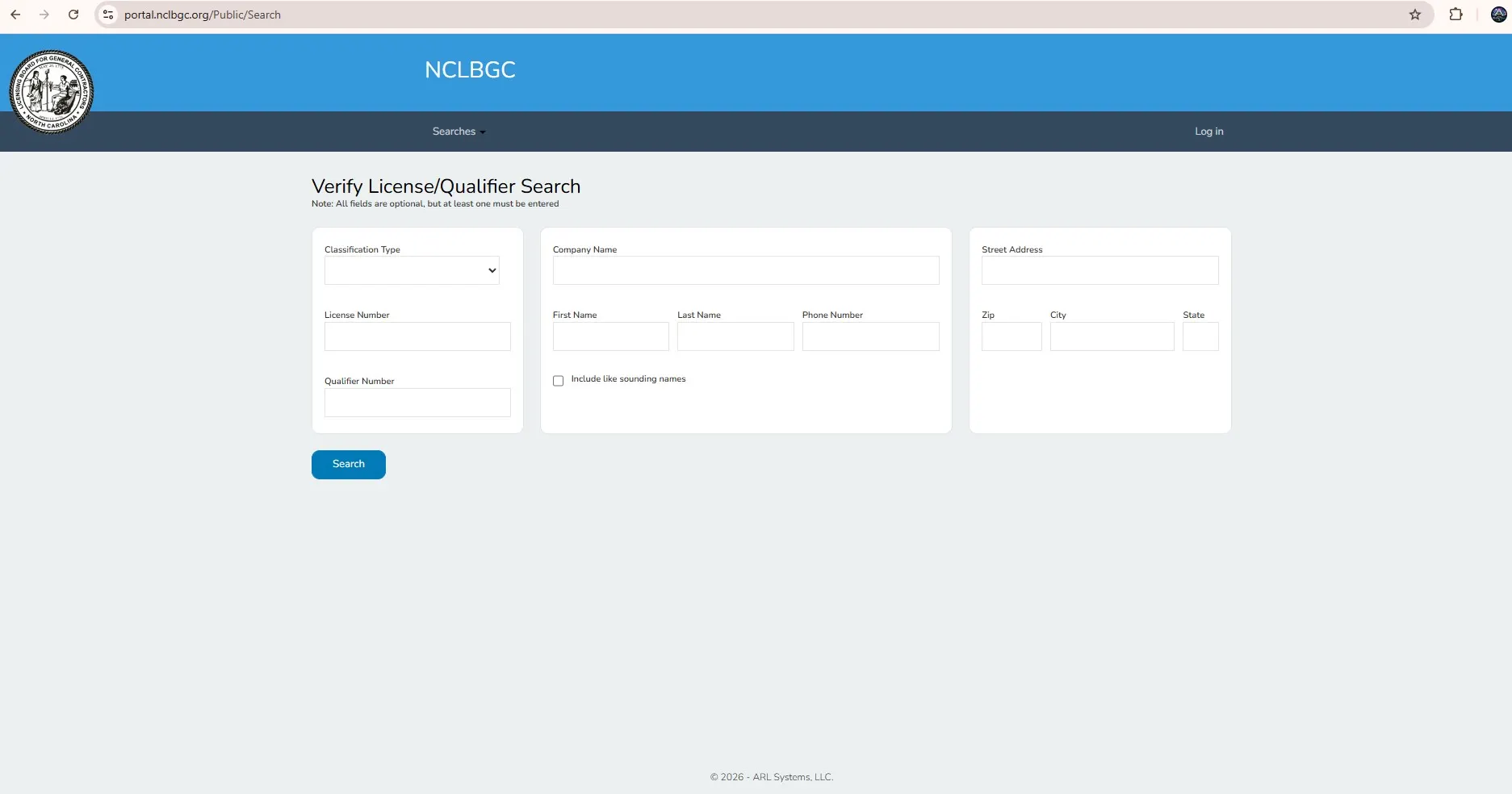
Use the strongest search field available
License number
Enter the complete number shown on the estimate, contract, permit application or advertisement. This is normally the fastest route to the correct profile.
Legal company name
Search the entity that will contract and receive payment. Do not search only a trade name or salesperson’s name.
Qualifier or location
Use qualifier number, person name, classification, address, city, ZIP or county when a license number is unavailable.
Read the complete profile, not only “active”
| Record field | Why it matters | What to compare | Stop when |
|---|---|---|---|
| Status | Shows whether the entity currently has authority to use the license. | Check before signing and again before work begins. | The record is invalid, expired, inactive or unavailable. |
| Legal licensee | Identifies the person or entity legally holding the license. | Contract, invoice, payment recipient and permit application. | Another LLC or corporation proposes using the displayed license. |
| Qualifier | Shows the person whose accepted examination supports the classification. | Confirm the qualifier remains associated with the licensee. | Only the qualifier appears but the contracting entity is not licensed. |
| Classification | Controls the type of general contracting work authorized. | Building, Residential, Highway, Public Utilities or Specialty scope. | The principal project work is outside the displayed classification. |
| Limitation | Controls the maximum value of an individual undertaking. | Use the complete connected project value. | The undertaking exceeds the Limited or Intermediate cap. |
| Discipline | Profiles may link to final disciplinary documents for qualifying cases filed from 2022 onward. | Read the order, date, violation and present license status. | Material discipline is hidden or misrepresented. |
If no license appears
- Remove punctuation and search the complete legal company name.
- Search the owner or qualifier’s first and last name.
- Try the county, city or ZIP search.
- Ask the bidder to provide the license number in writing.
- Confirm that the work belongs to NCLBGC rather than a separate electrical, plumbing or HVAC board.
- Do not accept a screenshot supplied by the contractor in place of the live record.
Tool 1: $40,000 License Threshold Checker
Enter the value of the complete connected construction undertaking—not only the deposit, first invoice, subcontract or one phase.
When an NC General Contractor License Is Required
A license is required when a covered construction contract or undertaking is valued at $40,000 or more. The rule applies to bidding, contracting, constructing or managing covered work.
$40,000 or more
The general contractor must hold an active license with the correct classification and sufficient project limitation.
Below $40,000
NCLBGC licensure may not be triggered, but permits, business requirements, written contracts and separate trade licenses can still apply.
Use the full undertaking
Count connected phases, change orders and related work rather than treating each invoice or subcontract as a separate project.
Examples that prevent threshold mistakes
| Scenario | Likely analysis |
|---|---|
| $36,000 remodel plus $8,000 approved change order | The connected undertaking reaches $44,000. Do not analyze only the original contract. |
| $25,000 addition and $20,000 roof under coordinated contracts | Related work can be treated as one undertaking depending on the facts. |
| $28,000 electrical project | The GC threshold may not apply, but an electrical contractor license and permit can still be required. |
| Modular-home setup and connected improvements exceeding $40,000 | General-contractor licensure can be required for setup and ancillary work. |
| Owner purchases materials directly | Do not assume owner-purchased materials automatically disappear from the undertaking analysis. |
Classification Controls Work; Limitation Controls Project Value
A contractor can have the correct dollar limitation but the wrong classification, or the correct classification but an insufficient limitation. Verify both.
Main classifications
| Classification | Typical authority | Practical check |
|---|---|---|
| Building | Broad private, public, commercial, industrial, institutional and residential building work. | Separate trade licenses may still be required. |
| Residential | Residences governed by the North Carolina Residential Code and related improvements. | Narrower than the full Building classification. |
| Highway | Highways, grading, paving, bridges, culverts, parking areas and airport surfaces. | Check whether connected utility or specialty work needs added authority. |
| Public Utilities | Water, sewer, communications, fuel-distribution and related utility systems. | Review the precise subclassification displayed. |
| Specialty | Defined work such as roofing, concrete, masonry, pools, marine construction or boring. | Does not override another occupational board’s jurisdiction. |
| Unclassified | Multiple classifications supported by accepted examinations. | CE treatment can depend on having a Building qualifier. |
Limited, Intermediate and Unlimited project caps
| Limitation | Maximum individual project | Working-capital or net-worth route | Surety alternative |
|---|---|---|---|
| Limited | Up to $750,000 | $17,000 working capital or $80,000 net worth | $175,000 continuous surety bond |
| Intermediate | Up to $1,500,000 | $75,000 working capital | $500,000 continuous surety bond |
| Unlimited | No single-project cap | $150,000 working capital | $1,000,000 continuous surety bond |
Tool 2: License Limitation Planner
Enter the largest complete individual project you expect to contract. This is planning help, not Board approval.
Financial Statements and Surety Documents
Financial eligibility is tied to the applicant entity. A personal bank balance or another company’s financial statement does not automatically satisfy the requirement.
Financial-report details applicants commonly miss
- The report should reflect the legal entity applying for the license.
- Financial information generally cannot be more than 12 months old.
- Reports must follow generally accepted accounting principles.
- Intermediate and Unlimited applicants should confirm the accepted CPA-report format before ordering expensive accounting work.
- An agreed-upon procedures report can be accepted in situations where applicants assume only an audit is allowed.
- Working capital is generally current assets minus current liabilities.
Continuous surety-bond details
The alternative bond must use the amount associated with the requested limitation, remain continuous, name the State of North Carolina as obligee and meet the Board’s insurer and cancellation-notice requirements.
How to Apply for an NC General Contractor License
North Carolina applications are submitted online. Prepare the legal entity, qualifier, finances, background information and examination route before paying nonrefundable costs.
Choose the exact legal license entity
Apply in the name that will bid, contract, invoice and receive payment. A license issued to an individual does not automatically authorize an LLC or corporation owned by that individual.
Select the classification and limitation
Choose both the construction scope and maximum individual project value. Correcting these after filing can require additional review and cost.
Identify an eligible qualifier
The qualifier must be connected to the applicant as a responsible managing employee, owner, corporate officer, LLC member or qualifying partner.
Prepare financial responsibility
Use the working-capital or net-worth route, accepted financial reporting, or the correct continuous surety-bond alternative.
Prepare character references and background information
The application requires good-moral-character information and entity-specific criminal-background checks. Prepare every required person before starting.
Submit through the online portal
Paper applications are not the normal application route. Use identical names across entity records, financial documents, references and qualifier information.
Complete the examination route
After eligibility review, schedule the required PSI examination unless the Board accepts a NASCLA result or an examination waiver.
Wait for Board approval and verify issuance
Passing the examination does not itself create a license. The Board must approve the application, and the public portal should display the issued license before covered work begins.
Who may need a background check?
| Applicant structure | People generally included |
|---|---|
| Sole proprietorship | The proprietor. |
| Corporation | The corporate president. |
| Limited liability company | All managers and members required by the application rules. |
| Partnership | All partners. |
Tool 3: Application Readiness Checklist
Select only the items already prepared. The result identifies missing planning items before you enter the application portal.
Application Fees and Realistic Processing Time
Board fees vary by limitation. Examination, background-check, accounting, continuing-education and payment-processing charges can be separate.
| Transaction | 2026 Board fee | Planning note |
|---|---|---|
| Limited application or renewal | $75 | Verify the complete portal total before paying. |
| Intermediate application or renewal | $100 | Financial-report preparation can add professional costs. |
| Unlimited application or renewal | $125 | Financial-report preparation can add professional costs. |
| Increase to Intermediate | $100 | Submit separately from ordinary renewal. |
| Increase to Unlimited | $125 | Submit separately from ordinary renewal. |
| Late renewal | $10 per month or part | Applies after January 1 in addition to the renewal fee. |
| Credit-card payment | Portal currently displays 2.5% | Review the checkout total before final submission. |
Realistic application timing
Initial review
Official guidance describes approximately two weeks for initial processing before corrections, examination eligibility or Board-review preparation.
Exam already complete
A complete application with the required examination already satisfied can take approximately 30 days.
After examinations
Typical processing can take another two to three weeks, subject to Board approval scheduling.
PSI Exams, NASCLA and Examination Waivers
The qualifier’s accepted examination supports the license classification. It is not an independent occupational license and cannot be lent to another business.
North Carolina PSI route
Apply first. After the Board determines eligibility, follow the PSI scheduling instructions issued for the required examination.
NASCLA Building exam
The NASCLA Accredited Building Examination can support the Building classification, but the North Carolina application remains required.
Waiver-state route
The Board lists examination-waiver agreements with South Carolina, Tennessee, Louisiana, Georgia, Mississippi, Alabama and Florida.
What Happens When a Qualifier Leaves
The qualifier must remain properly connected with the licensee. A qualifier can support no more than two licenses.
The 90-day period is not permission to take new work
When a license loses its only qualifier for a classification, the rules provide a limited period to replace that qualifier before the license becomes invalid. During that period, the licensee cannot use the affected classification to bid or undertake new contracts.
- Report the qualifier change promptly through the correct Board process.
- Do not wait until renewal to correct the relationship.
- Do not bid new work under an unsupported classification.
- Confirm the replacement qualifier appears on the live public record.
- Remember that the license itself cannot be transferred to another entity.
Entity changes are not simple profile edits
Changing from a sole proprietorship to an LLC, merging corporations or moving work to a different company can affect the legal licensee. Contact the Board before using an existing license number under a newly formed entity.
Bond, Insurance and Workers’ Compensation Requirements
These requirements are often confused. NCLBGC does not universally require every general contractor to use the financial-alternative bond or carry the same liability-insurance policy.
License bond
The $175,000, $500,000 or $1,000,000 continuous bond is an alternative financial-qualification route, not a universal requirement for every licensee.
Liability insurance
The Board’s licensing rules do not establish one universal liability limit for every general contractor, but owners, lenders, contracts and local authorities may require coverage.
Workers’ compensation
North Carolina businesses with three or more employees generally must carry workers’ compensation, subject to statutory exceptions and classification rules.
Renewal, Continuing Education and Limitation Increases
North Carolina general contractor licenses renew annually. License status, qualifying-person association, financial responsibility and continuing education can all affect renewal.
| Renewal issue | Current rule | Practical action |
|---|---|---|
| Annual expiration | Licenses expire January 1 unless renewed for the new license year. | Begin renewal before year-end. |
| Late renewal | $10 per month or part after January 1. | Do not continue covered work based on a submitted payment alone. |
| Invalid status | An invalid license cannot be used to conduct licensed general contracting business. | Confirm the live status after renewal. |
| Four-year lapse | A license invalid for four consecutive years is archived and cannot be renewed normally. | Contact the Board about new-applicant requirements. |
| Limitation increase | Increases can be requested online but are not processed as part of ordinary renewal. | Submit the separate increase request and financial documents. |
Eight-hour continuing-education rule
Building, Residential and qualifying Unclassified licenses require at least one qualifier to complete eight approved hours: a two-hour mandatory course and six hours of approved electives.
Two mandatory hours
The Board’s current mandatory course covers laws, rules and subjects selected for that CE year.
Six elective hours
Complete approved elective courses through recognized providers.
November 30 cutoff
The CE year runs January 1 through November 30. Board-approved classes are not offered in December.
Owner-Builder Is Not a License Shortcut
The owner-builder route places real contracting, payment, supervision and inspection responsibilities on the legal property owner.
The deed owner applies
The legal owner shown on the deed uses the owner-builder route. A spouse not listed as owner cannot automatically substitute.
The owner actively manages
The owner hires, receives invoices from, supervises and pays subcontractors and suppliers.
The owner handles inspections
The owner schedules and may be required to be present for inspections under the applicable affidavit.
Homeowner Contractor and Contract Checklist
An active license is essential for covered projects, but it does not replace references, insurance, permits, lien protection or a detailed contract.
Verify before signing
- Active NCLBGC license.
- Exact legal entity match.
- Correct classification.
- Limitation covers the full undertaking.
- Qualifier remains associated.
- Required trade licenses are active.
- Insurance is confirmed with the agent.
- At least three recent references are contacted.
Do not proceed when
- The company asks to use another entity’s license.
- The requested payment name differs from the licensee.
- The project is divided to avoid the threshold.
- The limitation is below the full project value.
- A large advance payment is demanded without protection.
- The contractor refuses a detailed written contract.
- Permit responsibility is unclear.
- An out-of-state license is presented as North Carolina authority.
Contract terms that complete the license check
| Contract item | What it should state |
|---|---|
| Contractor identity | Legal name, address, telephone number and license number. |
| Scope and materials | Brands, models, quantities, finishes, exclusions and subcontracted work. |
| Total price | The complete connected project value. |
| Payment schedule | Progress payments tied to completed work and delivered materials. |
| Permits | Who obtains permits, schedules inspections and corrects failures. |
| Insurance | Required liability and workers’ compensation documentation. |
| Changes | Written change-order approval, added price and added time. |
| Final payment | Completion, final inspection, punch list, warranty documents and lien releases. |
Complaint Requests and Homeowners Recovery Fund
NCLBGC accepts complaint requests involving licensed general contractors and unlicensed contractors when the covered contract is valued at $40,000 or more.
Prepare before opening the paperless complaint form
- Correct contractor and licensee identity.
- License number when one exists.
- Complete contract and every change order.
- Project value and job address.
- Payments, invoices and receipts.
- Dated photographs and videos.
- Permit and inspection records.
- Emails, texts and written correction requests.
- Witness names and contact details.
- A short chronological summary of events.
Disciplinary documents on public profiles
The Board’s current paperless process can place links to final disciplinary documents on public license profiles for qualifying complaints filed from 2022 onward that result in discipline. Read the document itself instead of judging only from a short label.
Homeowners Recovery Fund eligibility path
The Fund is a last-resort process for qualifying current or former owners of a single-family dwelling who suffer reimbursable loss caused by dishonest or incompetent conduct by a licensed general contractor, or by an unlicensed contractor who falsely represented that the contractor was licensed.
Typical prerequisites
- The claimant owned or formerly owned the affected dwelling.
- The loss resulted from qualifying dishonest or incompetent conduct.
- The loss was not paid by the contractor, bond, surety or insurance.
- Available civil remedies were exhausted.
- A judgment was obtained and remains unpaid.
Important limits
- A claim is not the first step in an ordinary dispute.
- Bankruptcy remedies must be exhausted when applicable.
- Attorney fees, court costs and punitive damages are not reimbursable.
- Payment of the entire loss is not guaranteed.
- An award is a statutory privilege rather than an automatic right.
A judgment-based application generally must be filed within one year after civil proceedings, including appeals, conclude. Different discovery and outer deadlines can apply in bankruptcy, death or dissolution situations, so legal advice may be necessary.
Electrical, Plumbing, HVAC and Local Permit Checks
An NCLBGC license does not replace licenses issued by North Carolina’s electrical, plumbing, heating or fire-sprinkler boards.
| Work | Additional verification | Practical action |
|---|---|---|
| Electrical | North Carolina electrical contractor license. | Verify the exact electrical entity and classification in the electrical board search. |
| Plumbing | Plumbing contractor license and applicable classification. | Search the state plumbing and heating licensing portal. |
| Heating and HVAC | Heating contractor license and relevant group or class. | Verify before accepting a general contractor’s assurance. |
| Fire sprinkler | Applicable fire-sprinkler licensing authority. | Confirm both company and individual requirements. |
| Building and remodeling | City or county permit and inspection requirements. | Confirm permit responsibility in the written contract. |
North Carolina Licensing Board Contact Help
Most applications, renewals, limitation increases and complaint requests are handled online. Prepare the correct identifiers before calling or visiting.
Telephone
Use the main number for licensing, application and account questions.
Raleigh office
5400 Creedmoor Road
Raleigh, NC 27612
Have these details ready
- License, qualifier, application or complaint-request number.
- Exact legal entity name.
- Classification and limitation.
- Complete project value.
- Portal status or exact error message.
- Date the application, renewal or complaint was submitted.
- Names of documents already uploaded.
- One concise question for Board staff.
Common North Carolina Licensing Mistakes
Using the qualifier as the licensee
The contracting entity must hold the license even when a connected person passed the examination.
Checking only active status
The legal entity, classification, limitation and disciplinary information also matter.
Using the old $30,000 threshold
The current covered-project threshold is $40,000 or more.
Understating the undertaking
Use connected work and approved changes rather than one invoice or project phase.
Buying an unnecessary bond
The limitation bond is an alternative financial route, not a universal license requirement.
Waiting until December for CE
The CE year ends November 30 and approved courses are not offered during December.
NC Contractors Licensing Board FAQs
What is the official North Carolina contractors licensing board?
The official agency is the North Carolina Licensing Board for General Contractors, commonly abbreviated as NCLBGC.
When is an NC general contractor license required?
A North Carolina general contractor license is required when a covered construction contract or undertaking is valued at $40,000 or more.
How do I verify a North Carolina general contractor?
Use the official NCLBGC public search. Search by license number, qualifier number, company, person, classification, address, city, ZIP or county, then review the full license profile.
What is the difference between a licensee and a qualifier?
The licensee is the legal individual or business authorized to contract. The qualifier is the connected person whose accepted examination supports the license classification.
What are the Limited, Intermediate and Unlimited project caps?
A Limited license covers individual projects up to $750,000, an Intermediate license covers projects up to $1,500,000, and an Unlimited license has no single-project value cap.
What financial requirements apply to an NC contractor license?
Limited applicants need $17,000 working capital or $80,000 net worth, Intermediate applicants need $75,000 working capital, and Unlimited applicants need $150,000 working capital. Approved continuous surety-bond alternatives are also available.
Are bond and liability insurance required for every NC contractor license?
No universal limitation bond or liability-insurance amount applies to every NCLBGC licensee. The continuous bond is an alternative financial route, while owners, contracts, lenders and other laws may separately require insurance.
Does North Carolina accept NASCLA or out-of-state examinations?
NCLBGC accepts the NASCLA Accredited Building Examination for the Building classification and maintains examination-waiver agreements with listed states, but every applicant must still complete the North Carolina licensing process.
How much continuing education is required?
Qualifying Building, Residential and Unclassified licenses require eight annual hours: a two-hour mandatory course and six approved elective hours completed during the January 1 through November 30 CE year.
Does a Board complaint guarantee repairs or reimbursement?
No. The licensing complaint process can investigate and discipline, but it does not itself order repairs, completion, restitution or payment. The Homeowners Recovery Fund is a separate last-resort process with additional legal requirements.
Verify the Entity Before Work Begins
Homeowners should confirm the active licensee, classification, limitation, qualifier, trade credentials, insurance and permits before paying. Applicants should align the entity, finances, background checks and examination route before submitting nonrefundable costs.