
Check the CCB License Before You Hire, Bid or Renew
The Oregon Construction Contractors Board is the state agency most homeowners and contractors mean when they say “Oregon CCB.” It handles contractor licensing, license lookup, bonds, liability insurance records, renewal, compliance, consumer complaints and dispute-resolution routing.
Use this page when you need the official license search, want to apply for a new CCB license, compare residential and commercial endorsements, renew a license, or understand what Oregon homeowners should verify before paying a contractor.
Quick Answer: What the Oregon Construction Contractors Board Does
The Oregon Construction Contractors Board licenses many businesses and individuals who perform construction activity for compensation on real property in Oregon. The CCB license search can help a homeowner check active licensing, bond information, liability insurance proof submitted to CCB, lead-based paint licensing where shown, workers’ compensation information and complaints or disciplinary actions shown for the past 10 years.
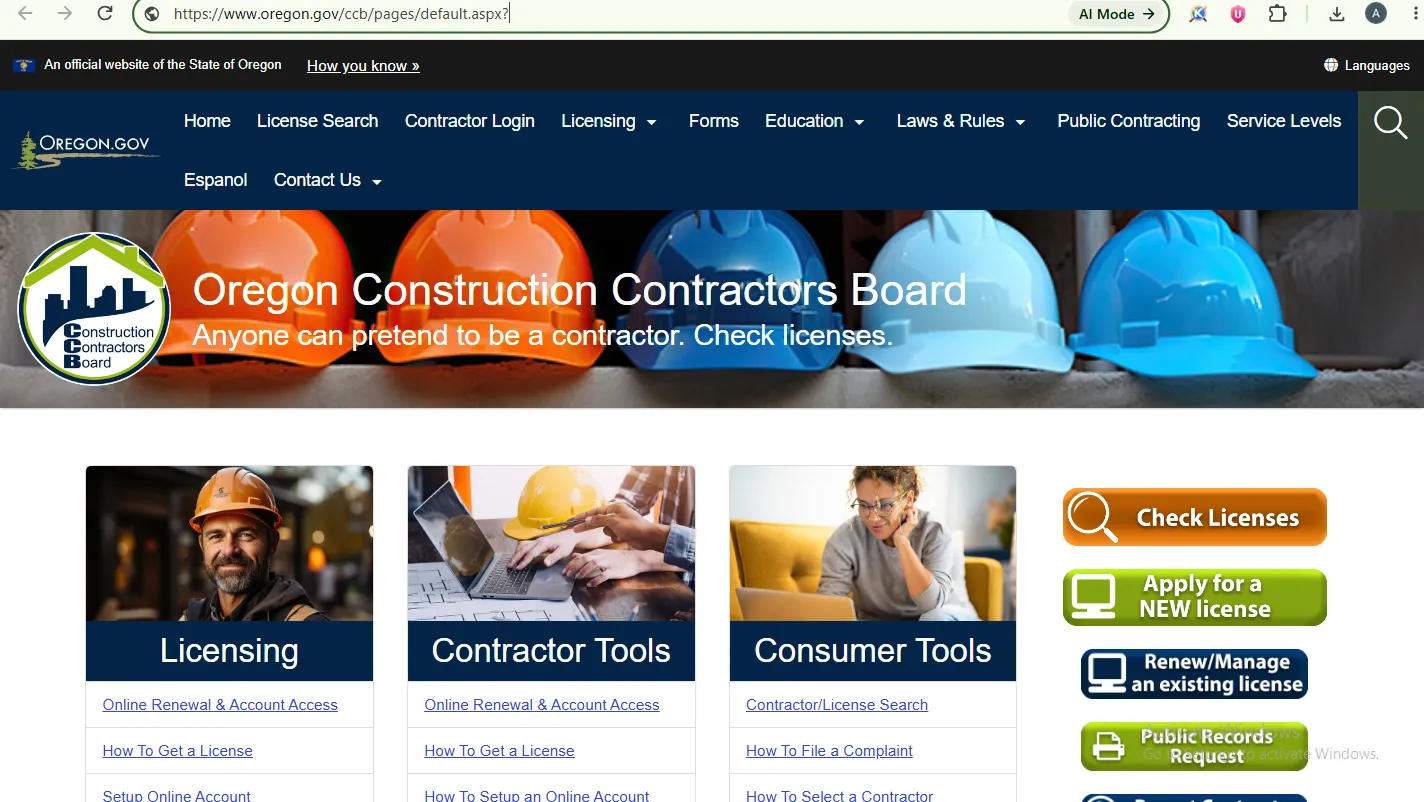
Official Oregon CCB Screenshot for This Page
This screenshot should sit near the top of the article because readers searching this title usually want to confirm they are on the correct official agency path before using the lookup or application links.
Official Oregon CCB Links Readers Usually Need
Use these links after you understand what you are checking. The CCB website and official search tool control live license status, application routing, renewal and complaint processing.
For homeowners checking a contractor
Start with the official license search. Search by CCB number when available, then compare the legal business name, status, bond, insurance and complaint history shown in the record.
For contractors applying or renewing
Use the official CCB licensing page for current application steps, pre-license training, exam notes, bond and insurance requirements, renewal and account access.
For endorsement and bond questions
Residential, commercial and restricted endorsements have different work scopes, bond amounts and insurance levels. Use the endorsement chart before choosing a license path.
For complaints and illegal activity
Oregon has separate paths for consumer disputes, illegal construction activity, unlicensed work, payment disputes and bond access. Do not wait until documents are missing.
How to Use the Oregon CCB License Lookup Correctly
The Oregon CCB lookup is more useful when you treat it like a matching exercise. The point is not just finding a similar name. The point is confirming that the same licensed business is the one advertising, bidding, contracting, pulling permits and taking payment.
Search by CCB number first
If the bid, truck, website, contract or business card shows a CCB number, use that number first. Name searches can miss records because businesses may use legal names, assumed business names, owner names or trade names.
Open the exact license record
Do not rely on a search-result preview. Open the record and review the license status, entity name, endorsement, expiration, bond, insurance, workers’ compensation information and any complaint or disciplinary history the official system shows.
Match the business name against the paperwork
The contractor name in the CCB record should make sense against the estimate, contract, invoice and payment name. A mismatch is not always fraud, but it is always worth pausing and asking for a written explanation.
Check whether the endorsement fits the job
A residential specialty endorsement, commercial general endorsement, commercial specialty endorsement or restricted residential endorsement can carry different limits. Match the endorsement to the project type before assuming the contractor is properly licensed.
Recheck before signing or paying
Live status can change. Reopen the official CCB search before signing a contract, paying a deposit, allowing demolition, or letting a contractor start work on your Oregon property.
Who Usually Needs an Oregon CCB License?
Oregon CCB guidance says Oregon law generally requires anyone who works for compensation in construction activity involving improvements to real property to be licensed. The agency lists common examples such as roofing, siding, painting, carpentry, concrete, heating, air conditioning, electrical work, plumbing, tree servicing, home inspection, manufactured dwelling installation, land development, handyman work and most construction or repair services.
Common work that can fall under CCB licensing
- Residential remodels, repairs, additions and general construction
- Roofing, siding, painting, carpentry, floor covering and concrete
- Heating and air conditioning work when the business needs a CCB license layer
- Tree service, chimney inspection or sweeps, land development and manufactured dwelling installation
- Home inspections, locksmith services, home energy performance score work or other special CCB categories when applicable
Examples the CCB lists as not requiring a CCB license
- Gutter cleaning
- Power or pressure washing when the purpose is cleaning
- Debris cleanup from a yard or construction site
- Qualified real estate property managers managing a building under a property management agreement
How to Apply for a New Oregon CCB License
For most new contractor-license paths, Oregon’s application workflow is built around a Responsible Managing Individual, the correct endorsement, business setup, bond, liability insurance and application documents.
Choose the Responsible Managing Individual
The RMI must be an owner or employee who manages or supervises the business’s construction activities. Most endorsements require an RMI, although several restricted categories do not.
Complete training and exam
The RMI generally completes 16 hours of approved pre-license training and passes the Oregon contractor exam. Applicants with the NASCLA commercial contractor exam still need the Oregon law, rules and business-practices exam.
Select the endorsement
Residential, commercial and dual work need different endorsement choices. A contractor working on residential and large commercial structures may need both residential and commercial endorsements.
Set up the business name
File the corporation, LLC, partnership or assumed business name with the Oregon Secretary of State when required. A business filing is not a CCB license, but the licensing paperwork must match the business identity.
Prepare bond and insurance
The application needs the correct surety bond with power of attorney and a certificate of general liability insurance. The insurance certificate must name the Construction Contractors Board as certificate holder.
Submit the complete application
CCB warns that missing documents and application errors cause delays. Electronic applications may take about four to six weeks, while paper applications may take about six to eight weeks.
Oregon CCB Fees, Exam Details and Renewal
Oregon CCB fees changed for initial applications received after June 30, 2025. For current planning, use the $400 initial license application fee and $400 renewal fee unless the official CCB page shows a newer amount.
| Item | Current detail | What it means in practice |
|---|---|---|
| Oregon contractor exam | $60, paid to the exam provider | The exam has 80 multiple-choice questions, a 70% passing score, and a three-hour time limit. |
| Initial CCB application | $400 beginning July 1, 2025 | Prepare the bond, insurance certificate, signatures and documents before submitting online. |
| CCB renewal | $400 every two years | A contractor can complete online renewal and payment through the official CCB account portal. |
| Endorsement change | $20 | Needed when the contractor’s work scope changes beyond the current endorsement. |
| Inactivation or reactivation | $20 | Useful when a business needs to pause or restore license activity under CCB rules. |
| Lead-Based Paint application | $50 | This is a separate CCB specialty path and does not replace the regular contractor license requirement. |
Oregon CCB Endorsements: Residential, Commercial and Restricted Work
The endorsement is where many Oregon contractor checks become more practical. A contractor can be licensed but still hold an endorsement that does not fit the project being proposed.
| Endorsement | Typical scope | Bond / insurance shown by CCB chart |
|---|---|---|
| Residential General Contractor (RGC) | May supervise, arrange for, or perform an unlimited number of unrelated building trades involving residential or small commercial structures. | $25,000 residential bond; $500,000 per occurrence insurance. |
| Residential Specialty Contractor (RSC) | Generally performs one or two unrelated building trades for residential or small commercial projects, with a limited multi-trade small-project path. | $20,000 residential bond; $300,000 per occurrence insurance. |
| Residential Limited Contractor (RLC) | Designed for part-time contractors such as handyman-style work, subject to gross sales and per-job limits. | $15,000 residential bond; $100,000 per occurrence insurance. |
| Residential Developer (RD) | For residential developers who arrange construction or development of property they intend to sell and do not perform the construction work themselves. | $25,000 residential bond; $500,000 per occurrence insurance. |
| Commercial General Contractor Level 1 (CGC1) | Commercial general work with Level 1 experience certification; may cover small or large commercial structures. | $80,000 commercial bond; $2 million aggregate insurance. |
| Commercial General Contractor Level 2 (CGC2) | Commercial general work with Level 2 experience certification. | $25,000 commercial bond; $1 million aggregate insurance. |
| Commercial Specialty Contractor Level 1 (CSC1) | Commercial specialty work involving one or two unrelated building trades, with Level 1 experience certification. | $55,000 commercial bond; $1 million aggregate insurance. |
| Commercial Specialty Contractor Level 2 (CSC2) | Commercial specialty work with Level 2 experience certification. | $25,000 commercial bond; $500,000 per occurrence insurance. |
| Commercial Developer (CD) | For developers who arrange commercial construction or development of property they intend to sell and do not perform the construction work themselves. | $25,000 commercial bond; $500,000 per occurrence insurance. |
Bond, Insurance, Workers’ Compensation and the License Search
Oregon homeowners often hear “bonded and insured,” but those words need a record check. CCB says its license search can tell you whether a contractor is actively licensed and has a surety bond, submitted proof of liability insurance when first licensed and at renewal, carries workers’ compensation insurance to protect workers, and has CCB complaints or disciplinary actions shown in the past 10 years.
Surety bond
The bond is tied to the license endorsement and may be relevant if a dispute reaches the legally required stage. A bond is not a simple refund button for unhappy customers.
Liability insurance
CCB requires proof of general liability coverage with the board as certificate holder, but homeowners should still ask for the current certificate and policy details before work begins.
Workers’ compensation
If the contractor has employees, workers’ compensation becomes part of the risk check. Do not assume a one-person business and an employer with crews have the same coverage situation.
Oregon Homeowner Hiring Check Before You Sign
Use this section if you are in Portland, Salem, Eugene, Bend, Medford, Gresham, Hillsboro, Beaverton or a smaller Oregon community and you are about to hire a contractor. The local permit office may vary, but the verification habits are the same.
Before the first payment
- Search the official CCB license number and save the result.
- Match the legal business name to the contract and payment name.
- Confirm the endorsement fits residential, small commercial or large commercial work.
- Check bond, liability insurance and workers’ compensation fields shown in the official record.
- Ask who will pull permits and which local building department will inspect the work.
- Get a written scope, start date, payment schedule, change-order process and warranty terms.
Slow down if you see this
- The contractor asks you not to check the CCB record.
- The payment name does not match the licensed business.
- The contractor wants cash only or a large upfront payment without a clear contract.
- The license is inactive, expired, suspended or missing from the official search.
- The contractor says no permit is needed but will not put that in writing.
- The bid is much lower than the others but leaves out labor, disposal, permit or material details.
Oregon CCB Complaints, Pre-Complaint Notice and Disputes
Oregon complaint rules are deadline-driven. A homeowner should gather paperwork early and use the CCB’s official complaint path instead of waiting until the contractor stops responding.
| Issue | What to know | Official starting point |
|---|---|---|
| Residential or some small commercial complaint | A 30-day pre-complaint notice by certified mail is generally required before filing with CCB. | Consumer Protection |
| Property owner complaint deadline | For an existing structure, CCB consumer guidance says the complaint form must be received within one year after substantial completion. | Consumer Tools |
| Processing fee | CCB says a $50 statutory processing fee applies to most complaints, and staff generally request payment after review. | Complaint Requirements |
| Unlicensed or illegal activity | The CCB enforcement path is used for reports of unlicensed and illegal construction activity. | Contractor Compliance |
| Bond recovery | Do not treat the bond as automatic payment. CCB warns that bond access requires the correct legal path. | Dispute Resolution Guidance |
Oregon Construction Contractors Board Contact and Office
Use these details for official licensing, consumer, enforcement and records questions. Do not send sensitive personal information through regular email unless the agency specifically asks for it.
Oregon Construction Contractors Board
CCB department contacts
Oregon Construction Contractors Board FAQs
What is the Oregon Construction Contractors Board?
The Oregon Construction Contractors Board, often called the Oregon CCB, is the state agency that licenses many construction contractors, manages contractor licensing resources, provides the CCB license search, handles compliance issues and routes consumer dispute information.
Where do I look up an Oregon CCB license?
Use the official CCB license search at search.ccb.state.or.us. Search by CCB number first when possible, then compare the legal business name, status, endorsement, bond, insurance and complaint information shown in the official record.
Does Oregon require every contractor to have a CCB license?
Oregon generally requires anyone working for compensation in construction activity involving improvements to real property to be licensed, but CCB lists some examples that do not require a license. Trade licenses, permits and local requirements may still apply.
Is a CCB license the same as an Oregon business registration?
No. A Secretary of State business filing identifies the business entity or assumed business name. A CCB license is a contractor regulatory credential. A contractor may need both, but they are not interchangeable.
Is a CCB license the same as a building permit?
No. A CCB license is tied to contractor licensing. A building permit is a project-specific approval handled by the local building department or permitting authority. A properly licensed contractor may still need permits for the job.
How much is the Oregon CCB license application fee?
For applications beginning July 1, 2025, CCB lists the initial application fee as $400. The Oregon contractor exam fee is listed separately at $60 paid to the exam provider.
How often does an Oregon CCB license renew?
A regular Oregon CCB license renews every two years. CCB lists the two-year renewal fee as $400, but contractors should always check the official CCB renewal page before paying.
What is the Oregon CCB Responsible Managing Individual?
The Responsible Managing Individual, or RMI, is the owner or employee who manages or supervises the construction activities of the licensed business. Most endorsements require an RMI.
Does passing NASCLA give me an Oregon contractor license?
No. Passing the NASCLA commercial contractor exam is not an Oregon license. CCB says applicants who passed the NASCLA Accredited Examination for Commercial General Building Contractors may skip the 16-hour pre-license training, but they still need the Oregon exam and must complete the Oregon CCB application process.
How do I file a complaint with Oregon CCB?
Use the official Oregon CCB Consumer Protection or Consumer Tools pages. For residential and some small commercial complaints, a 30-day pre-complaint notice by certified mail is generally required before filing.
Final Oregon CCB Check
For homeowners, the safest path is to check the official CCB license record, match the legal business name, confirm the endorsement, review bond and insurance details, ask about permits, and save every document before paying.
For contractors, the practical path is to choose the right endorsement, keep the RMI, bond, insurance, workers’ compensation, continuing education and renewal record current, and update the CCB when business details change.