
Check the CRLB Record Before You Sign
Rhode Island general contractors use state registration, while commercial roofers, home inspectors, utility contractors and licensed trades can follow different credential routes.
This guide shows homeowners how to verify the exact business and complaint history, and helps contractors prepare a first application, renewal, insurance documents, education and OpenGov uploads.
Rhode Island Contractor Lookup: Fast Answer
Search the official CRLB record by registration or license number whenever possible. Then match the legal company name, individual name, credential type and expiration to the estimate, contract, invoice, permit and payment recipient.
Use the Official Rhode Island CRLB Contractor Search
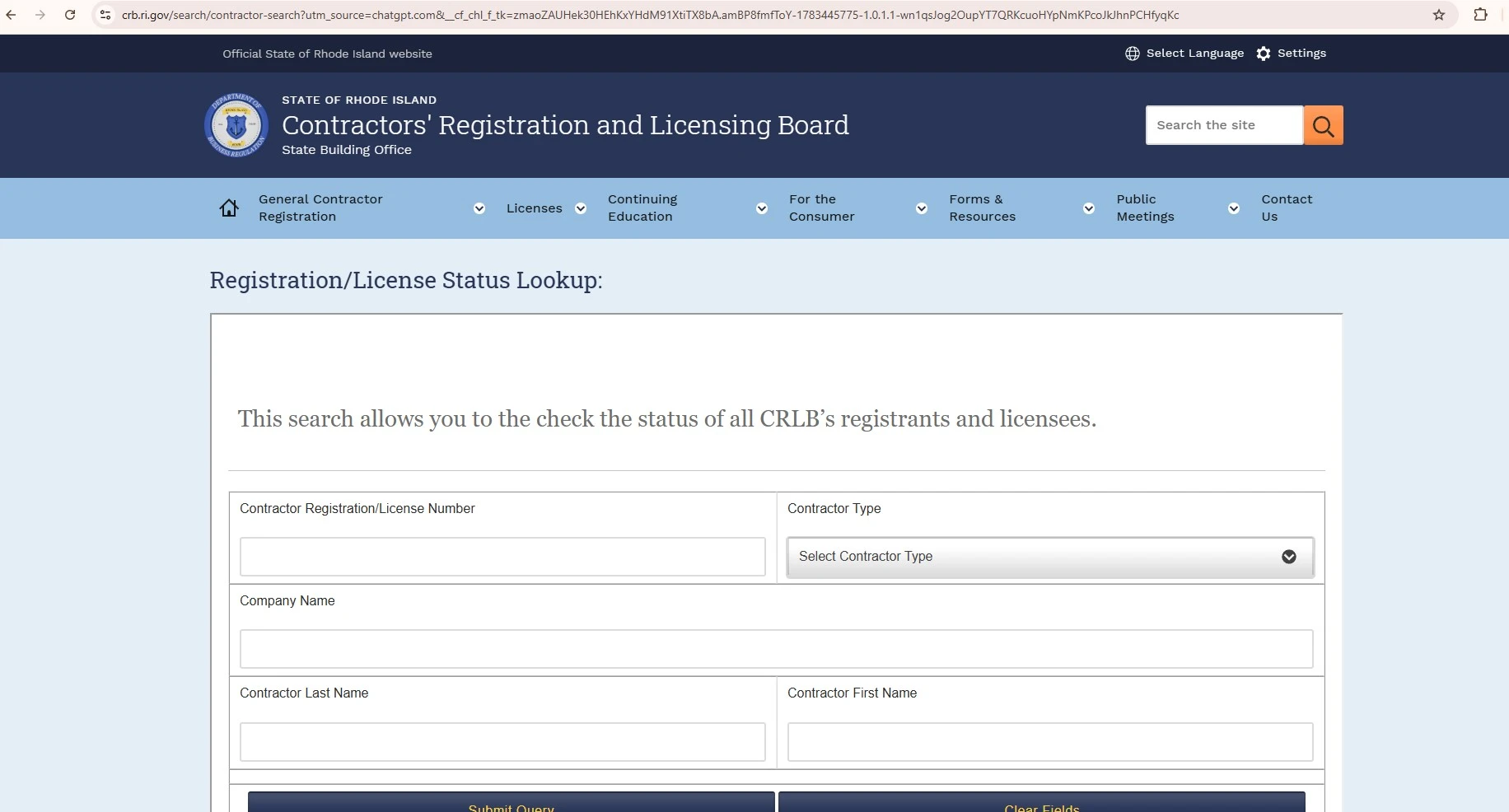
The CRLB status lookup accepts a contractor registration or license number, contractor type, company name, last name or first name. A number search is normally the most precise starting point.
Official Rhode Island contractor search preview
The image below shows the official state lookup form. The browser bar has been visually cropped so users can focus on the state search fields. Treat the screenshot as a guide only; always use the live state record.
Five-step verification sequence
Collect the exact legal identity
Ask for the complete legal company name, DBA, individual responsible person, registration or license number and the name that will receive payment.
Search the complete number first
Copy the number from the written proposal rather than typing it from memory. If no record appears, search the legal company name and last name separately.
Select the correct contractor type
A general registration, commercial roofing license, home-inspector license and underground utility license are different records. The wrong type filter can hide the correct result.
Match the result to every project document
The name should align with the bid, contract, invoice, certificate of insurance, permit application and requested payment recipient.
Save and recheck the record
Save a dated copy of the result. Recheck if the project start is delayed, the registration is near expiration or a different business arrives at the jobsite.
How to Read a Rhode Island Contractor Record
A visible name does not prove that the credential is current, belongs to the company taking payment or covers the proposed work.
| Record item | What it means | What to compare | When to stop |
|---|---|---|---|
| Status | Shows whether the registration or license appears current, expired, suspended or otherwise inactive. | Check the status before signing and again before work begins. | The record is expired, suspended, missing or unclear. |
| Legal name | Identifies the individual or entity responsible to the state. | Match it with the contract, invoice, permit and payment name. | Payment is requested to an unrelated person or business. |
| Credential type | Shows whether the record is general registration or a regulated license category. | Match the credential with the actual project scope. | A general registration is presented as authority for licensed electrical, plumbing or other regulated trade work. |
| Expiration | Shows when the credential must be renewed. | Make sure it will remain active when the work is performed. | The contractor says renewal is complete but the live record remains expired. |
| Company identity | Helps connect a person, company and DBA. | Check the Rhode Island Secretary of State business record. | The entity is inactive or the names cannot be reconciled. |
When no result appears
- Search without “LLC,” “Inc.” or punctuation.
- Try the contractor’s last name and first name separately.
- Confirm whether the number belongs to CRLB or Rhode Island DLT.
- Change the contractor-type filter.
- Check for a different registered business name or DBA.
- Contact CRLB before accepting “the state website has not updated” as an answer.
Tool 1: Contractor Record Match Checker
Use this after opening the official lookup. It organizes risk signals and does not replace the state record.
Check Complaints, Enforcement and Business Standing
The registration lookup is only one part of due diligence. Rhode Island also provides complaint guidance, enforcement decisions and a corporate database.
Consumer complaint history
CRLB’s consumer guidance directs homeowners to review contractor complaint information before hiring. Read dates and outcomes rather than judging only by a complaint count.
Enforcement cases
The DBR enforcement search can connect cases with a contractor’s legal name, company name or registration number, including affiliated companies.
Business entity status
The Secretary of State database helps confirm whether an LLC, corporation or other entity is active and whether its name matches the CRLB record.
General Registration, CRLB Licenses and DLT Trade Licenses
Rhode Island does not use one universal contractor license. The correct record depends on the work being offered.
| Work type | Primary state route | Additional check |
|---|---|---|
| General construction, remodeling, repair or demolition | CRLB general contractor registration | Municipal permits and separately licensed trades. |
| Commercial roofing | CRLB commercial roofing license | Current insurance, education and local roofing permit. |
| Paid residential home inspection | CRLB home inspector or associate inspector license | The inspection company and individual license. |
| Underground utility work | CRLB underground utility license | Bond, insurance, examination and local utility permits. |
| Well drilling, pump or water filtration | Relevant CRLB regulated license | Health, water-system and municipal requirements. |
| Electrical, plumbing or mechanical/HVAC | Rhode Island DLT professional regulation | Company and individual trade credentials plus permits. |
Who Must Register as a Rhode Island Contractor?
Rhode Island rules cover contractors, remodelers and most subcontractors who build or repair residential or commercial structures and related property improvements.
Work commonly requiring registration
- General building and structural construction.
- Residential or commercial remodeling.
- Repairs, alterations and improvements.
- Demolition or relocation of structures.
- Decks, garages, sheds, fences, pools and qualifying appurtenances.
- Subcontracting on covered construction projects.
- Advertising, bidding or offering covered contractor services.
Limited exclusions and cautions
- An employee working for a properly registered contractor is not separately registered merely as an employee.
- An owner working on the residence in which the owner lives can follow an owner-permit route, subject to local rules.
- The rule defines casual, minor or inconsequential work narrowly: nonstructural, no health or safety effect and total value below $500.
- A business filing, tax account or local certificate does not replace CRLB registration.
How to Apply for Rhode Island General Contractor Registration
The fastest application is the one prepared before the portal is opened. Align the legal entity, identity document, education, insurance and workers’ compensation records first.
Confirm the correct credential route
General contractor registration is not the correct application for every regulated specialty. Identify the project types the business will advertise and perform.
Complete five hours of initial education
New general contractor applicants generally need five approved in-person credit hours completed during the 24 months before applying. Required topics include codes and standards, contracts, workplace safety, business practices and one construction-related elective.
Prepare government-issued identification
The current application instructions require a clear copy of a valid driver’s license, state ID, passport photo page or military ID.
Confirm the business entity and responsible person
Corporations, LLCs and partnerships should be properly recorded with the Rhode Island Secretary of State. Use the same entity name on the application, insurance and customer contracts.
Obtain at least $500,000 liability coverage
Provide a certificate of general liability insurance with the required minimum coverage and CRLB listed as certificate holder. Ask the insurance agent to prepare the certificate using the exact registered name.
Address workers’ compensation
Businesses with employees must maintain the required Rhode Island workers’ compensation coverage and provide the requested documentation.
Appoint a Rhode Island agent if nonresident
A nonresident applicant must complete the agent-of-service requirement using an eligible Rhode Island attorney or registered agent.
Submit the application and $150 fee
The official page permits card payment through the designated online platform or a mailed check where instructed. Incomplete submissions can delay processing.
Confirm approval in the public record
A payment receipt is not proof of active registration. Search the live CRLB record and print the certificate only after approval is reflected.
Tool 2: Application Readiness Checker
Select every item already prepared. The result identifies gaps but does not approve the application.
Renew a Rhode Island Contractor Registration
General contractor registrations are valid for one year. Current renewal instructions require a $150 fee and 2.5 hours of approved continuing education for residential contractors, subject to the commercial-only exemption.
| Renewal item | Current requirement | Common mistake |
|---|---|---|
| Renewal term | One year | Assuming the registration remains valid for two years. |
| Renewal fee | $150 | Using an outdated fee from an older guide. |
| Expired late fee | Additional $50 | Continuing to advertise or work while the record is expired. |
| Continuing education | 2.5 approved hours for the current renewal | Submitting an unapproved course or no completion certificate. |
| Expired over one year | Current CRLB instructions require the five-hour preregistration course | Trying to complete a normal renewal after a long lapse. |
| Insurance and workers’ compensation | Current documents using the correct legal entity | Uploading a certificate for an old business name. |
Renewal workflow
- Search the public record and record the expiration date.
- Complete the current approved education requirement.
- Confirm the government-issued ID is readable and current.
- Update liability and workers’ compensation attachments.
- Correct address, phone, email, DBA or entity information.
- Submit the $150 fee and $50 late fee if applicable.
- Recheck the public record after processing.
- Print the updated certificate from the portal.
Contracts, Insurance, Lien Notice and Permits
Registration verification should be followed by a written contract, direct insurance confirmation, permit review and payment controls.
Written contract requirements
Rhode Island consumer guidance states that contracting work over $1,000 should use a written contract. The contract should identify the legal contractor, registration number, scope, materials, price, payment stages, permit responsibility, change orders, schedule, cleanup and warranty.
| Contract item | What it should answer |
|---|---|
| Legal identity | Who is legally responsible and who receives payment? |
| Scope and exclusions | What is included, excluded, removed, repaired or installed? |
| Materials | Which brands, models, grades and substitutions are allowed? |
| Payment stages | Which measurable milestone triggers each payment? |
| Permits and inspections | Who files, pays, schedules and corrects failed inspections? |
| Change orders | Who may approve extra cost or time, and must approval be written? |
Registration number and mechanic’s lien notice
CRLB guidance requires contractors to display the registration or license number on applicable advertising, proposals, contracts and invoices. Written contracts must also contain the required Notice of Possible Mechanic’s Lien language.
Verify insurance directly
Ask the contractor’s insurance agent—not only the contractor—to send a current certificate. Check the insured name, policy dates, liability limit and whether the described business matches the CRLB record.
Verify the local permit
The contractor registration and project permit are separate records. Use the municipal directory to find the city or town building office serving the project address. Ask whether building, electrical, plumbing, mechanical, zoning, fire, flood-zone, coastal or historic approvals apply.
File a Rhode Island Contractor Complaint Before the Deadline
The CRLB homeowner complaint process primarily covers work performed on a residence. Commercial property work is not eligible through the homeowner complaint route, although enforcement or court options may still exist.
Complaint filing fee and basic scope
Rhode Island rules authorize a $25 complaint filing fee. The complaint should identify the contractor, explain the alleged breach or defective work and include documents showing what was promised, paid and performed.
One-year filing rules
| Complaint situation | General CRLB timing rule |
|---|---|
| Existing structure | Generally within one year after substantial completion or the date work ceased. |
| New structure | Generally within one year after first occupancy or closing, whichever is later. |
| Contractor never started | Generally within one year after the written contract date. |
| Contractor abandoned the project | Generally within one year after the contractor ceased work. |
| Supplier, employee or subcontractor debt | Generally within one year after the indebtedness was incurred. |
What CRLB may do
- Review whether the complaint falls within CRLB jurisdiction.
- Notify the contractor and request a response.
- Inspect work and review permit or contract evidence.
- Facilitate informal resolution or a settlement conference.
- Address registration violations and impose administrative sanctions or fines.
- Order return of a deposit in qualifying no-work/no-supplies situations.
What the process may not do
A contested monetary-damages award belongs to the courts. A settlement conference can produce an agreed repair, completion or payment solution, but CRLB is not a substitute for legal advice, a civil lawsuit or mechanic’s lien guidance.
Complaint evidence packet
- Contractor’s legal name and registration or license number.
- Signed contract and every change order.
- Invoices, receipts, cancelled checks and payment-app records.
- Dated photographs and videos.
- Permit, inspection and correction notices.
- Written requests for correction or refund.
- Replacement bids or expert reports where relevant.
- A dated timeline showing start, payments, problems and work stoppage.
Tool 3: Contractor Problem Route Finder
Select the issue closest to your situation. This gives a starting route and is not a legal deadline calculation.
Official Rhode Island Contractor PDFs and Resources
These sources answer different questions. Open the document that matches the task rather than relying on an old third-party summary.
| Official resource | Use it for | Important detail |
|---|---|---|
| General Guidance for Contractors | Advertising, contracts, registration number and lien notice duties. | Helps contractors organize compliance before starting work. |
| What Homeowners Should Know | Hiring, written contracts, insurance and complaint awareness. | Useful before signing or paying a deposit. |
| Notice of Possible Mechanic’s Lien | Required lien-warning language in written contracts. | Explains that unpaid subcontractors or suppliers may claim against the property. |
| Complaint Information Overview | Complaint allegations, documents and process. | Use before completing a complaint packet. |
| Settlement Conference Overview | Understanding mediation, negotiated repairs and payment agreements. | The conference is not a contested damages hearing. |
| Current CE Provider List | Finding approved 2.5-hour renewal courses. | Confirm provider approval before paying for a course. |
| Agent of Service Form | Nonresident applicants. | Requires an eligible Rhode Island agent for service of process. |
| OpenGov Upload Instructions | Adding or replacing insurance, education and identity attachments. | Use the email associated with the registration or license. |
Rhode Island CRLB Phone, Email and Office
Have the legal business name, registration or license number, project municipality and exact question ready before contacting the Board.
Phone
Use the credential number when asking about a specific public record.
dbr.contractorregistration@dbr.ri.gov
Do not email sensitive identity or financial information unless instructed.
Office
560 Jefferson Blvd, Suite 100
Warwick, RI 02886
Monday–Friday, 8:30 AM–4:00 PM. No walk-ins after 3:30 PM.
Rhode Island Contractor License Lookup FAQs
What is the official Rhode Island Contractors Board?
The official agency is the Rhode Island Contractors’ Registration and Licensing Board, commonly called CRLB or RICRLB. It registers general contractors, licenses several regulated contractor categories and handles consumer complaints and enforcement.
How do I look up a Rhode Island contractor?
Use the official CRLB status lookup and search by registration or license number, contractor type, company name, last name or first name. Then match the result with the contract, permit and payment name.
Is Rhode Island contractor registration valid for one or two years?
Current CRLB guidance states that general contractor registrations are valid for one year. Check the live expiration date because older guides may still describe a two-year cycle.
How much does Rhode Island contractor registration cost?
The current application and renewal fee is $150. An expired registration has an additional $50 late fee. Confirm the amount on the official CRLB page before paying.
What education is required for Rhode Island contractor registration?
Initial applicants generally need five approved in-person hours completed within the prior 24 months. Current residential renewals generally require 2.5 approved continuing-education hours, subject to the commercial-only exemption.
What insurance does a Rhode Island general contractor need?
The official application requires at least $500,000 in general liability coverage with CRLB named as certificate holder. Workers’ compensation requirements also apply when the business has employees.
Does an out-of-state contractor need Rhode Island registration?
Yes, when performing covered work in Rhode Island. General contractor reciprocity is not available, and a nonresident applicant generally must appoint an eligible Rhode Island agent of service.
Where do I check a Rhode Island electrical or plumbing license?
Use the Rhode Island Department of Labor and Training professional license search for electrical, plumbing, mechanical and other regulated trade credentials.
How long do I have to file a complaint against a Rhode Island contractor?
Many CRLB complaint situations use a one-year deadline, but the starting date depends on whether the matter involves a new structure, existing structure, failure to start, abandonment or unpaid debt. Review the official statute promptly.
Does active CRLB registration prove that the project has a permit?
No. Contractor registration and project permits are separate. Verify building and trade permits with the city or town building department serving the project address.
Verify Three Things Before Work Begins
Homeowners: confirm the CRLB credential, legal business identity and local permit before releasing a major payment.
Contractors: keep the annual registration, education, insurance, workers’ compensation and OpenGov attachments current, and make sure the legal name matches every customer document.