
Verify the Credential Before Work Begins
Rhode Island uses general contractor registration, separate CRLB specialty licenses and separate DLT trade licenses. Check the exact person or business signing the contract, receiving payment and performing regulated work.
This practical guide explains the official search result, application documents, annual renewal, insurance, education, contracts, permits and complaint routes before you enter the state portal.
Rhode Island Contractor Registration: Quick Answer
Rhode Island’s official contractor agency is the Contractors’ Registration and Licensing Board, commonly called CRLB or RICRLB. General construction businesses and subcontractors generally use CRLB registration.
Commercial roofing, home inspection, underground utilities, water filtration, well drilling and pump installation use category-specific CRLB licenses. Electrical, plumbing and mechanical credentials are generally checked through Rhode Island DLT.
Rhode Island Contractor License and Registration Lookup
Use the official CRLB search for the exact person or company named on the estimate, written contract and payment request. Search the registration or license number first when available, then repeat the search using the legal business and responsible person.
Collect these details before opening the search
- Complete legal company name and any advertised DBA.
- Name of the responsible contractor or business owner.
- CRLB registration or license number.
- Exact work being offered, such as remodeling, commercial roofing or inspection.
- Electrical, plumbing or mechanical license numbers when those trades are included.
- Proposed project address and expected starting date.
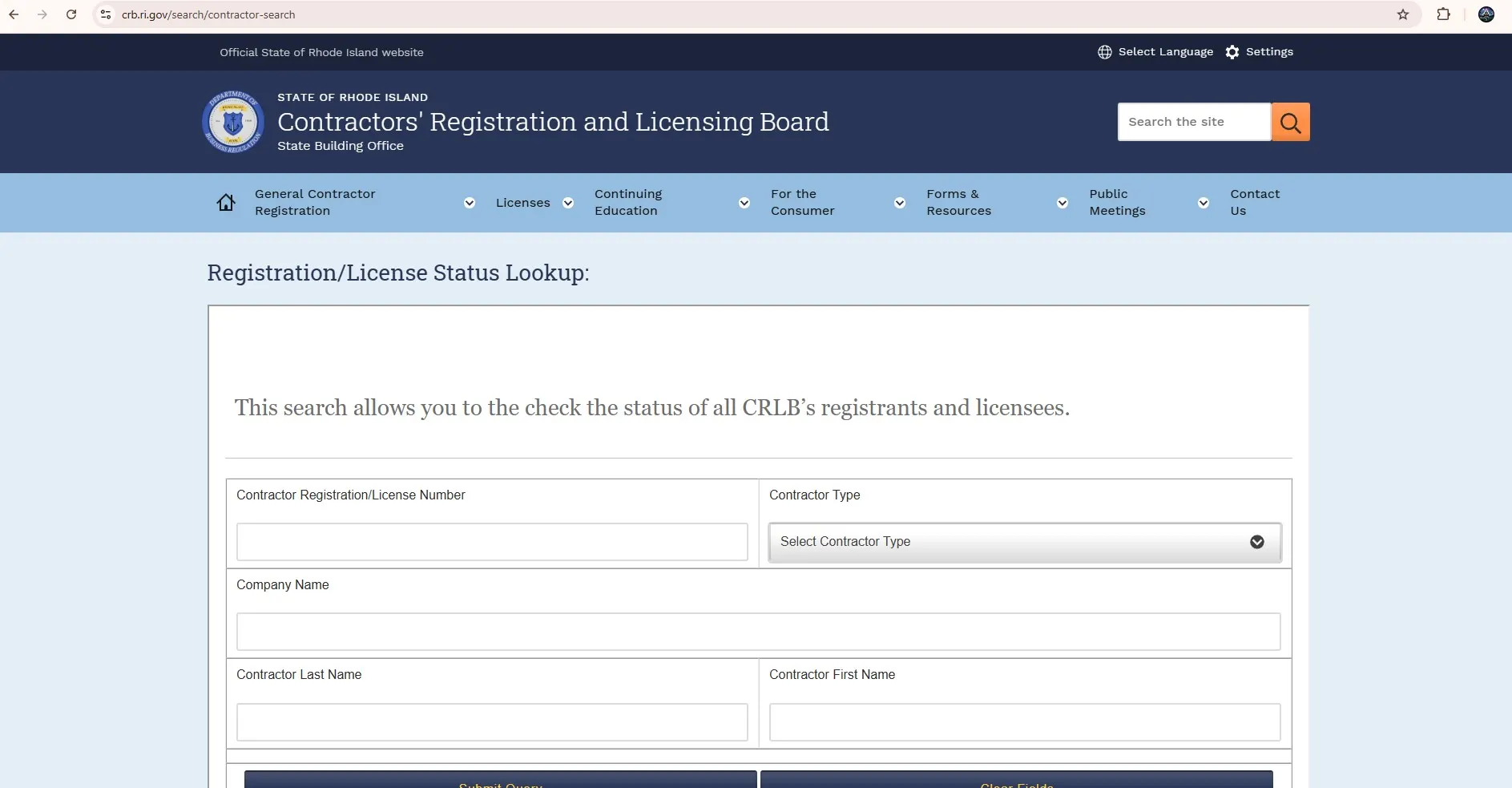
Search in this order
Enter the credential number
Use the full CRLB number printed on the bid or contract. A number search reduces confusion between companies with similar names.
Search the legal business
Repeat the search using the company name without unnecessary punctuation. Try the legal name and any DBA separately.
Search the responsible person
A person may be associated with more than one company. Review affiliated entities and enforcement information where available.
Save and recheck the result
Save a dated copy before signing. If the project begins weeks later, repeat the lookup before work starts or a major payment is released.
How to Read the CRLB Result Before Signing
The record should answer three separate questions: Is the credential current? Does it belong to the contractor asking for payment? Does the credential fit the work?
| Record field | What to verify | Warning sign | Practical next step |
|---|---|---|---|
| Status | The registration or license is current through the planned project start. | Expired, inactive, suspended, revoked or not found. | Do not rely on an application receipt; wait for a current public status. |
| Expiration | The annual registration will not expire before work begins. | Expiration falls between contract signing and project start. | Require proof of completed renewal and recheck the live record. |
| Legal identity | The company and responsible person match the proposal, contract, invoice and payment recipient. | Payment is requested by an unrelated person or entity. | Obtain a written explanation before paying. |
| Credential category | The registration or license covers the work being sold. | General registration is used to justify separately licensed work. | Search the correct CRLB specialty or DLT trade credential. |
| Insurance | A current certificate is issued in the same legal name. | Expired certificate, edited image or different policyholder. | Request confirmation directly from the insurance agent. |
| Enforcement history | Review available cases linked to the person and affiliated companies. | A material official case is denied or concealed. | Ask for a written explanation and supporting resolution documents. |
When no record appears
- Remove punctuation and business suffixes such as LLC or Inc.
- Search the person’s name and the company separately.
- Ask for the number in writing rather than accepting a verbal number.
- Check whether the credential belongs in the CRLB or DLT system.
- Check for a recently changed company or responsible person.
- Call CRLB before treating a missing record as a harmless database issue.
- Do not release a large deposit while identity or status remains unresolved.
Registration search and enforcement search are different
The credential search answers whether a registration or license exists and its status. Rhode Island also provides an enforcement-case search that can connect a person with cases involving affiliated businesses. Use both before a high-value project.
Tool 1: Contractor Record Triage
Complete this after checking the live state record. The result is planning help only and does not replace CRLB, DLT, an insurance agent, building official or attorney.
Registration, CRLB License or DLT Trade License?
Rhode Island does not use one universal contractor license. The correct credential depends on the work, and mixed projects commonly require more than one state check plus municipal permits.
| Work category | Main state path | What to verify | Common mistake |
|---|---|---|---|
| General construction, repair or remodeling | CRLB general contractor registration. | Current annual registration, insurance and legal identity. | Calling registration a universal trade license. |
| Commercial roofing | CRLB commercial roofing license. | Commercial roofing category, education and insurance. | Using general registration alone for licensed commercial roofing. |
| Home inspection | CRLB home inspector or associate inspector license. | Correct inspector category and active individual credential. | Assuming contractor experience replaces inspector licensure. |
| Underground utilities | CRLB underground utility license. | License, education, insurance and responsible person. | Treating utility work as ordinary general construction. |
| Well, pump or water filtration | Specific CRLB water-related license. | Exact activity and matching license category. | Using one water-related credential for every activity. |
| Electrical, plumbing or mechanical | Rhode Island DLT Professional Regulation. | Company and individual trade credentials. | Assuming CRLB registration replaces DLT licenses. |
Tool 2: Credential Path Finder
Select the main activity. A project involving several activities may require several credentials.
How to Apply for General Contractor Registration
Prepare the course, insurance, workers’ compensation, business entity and nonresident-agent information before starting the portal application. Files that use inconsistent names commonly cause delays.
Confirm general registration is the correct credential
Use the relevant specialty-license page instead when the work is commercial roofing, home inspection, underground utilities, well drilling, pump installation or water filtration.
Complete approved pre-registration education
First-time general contractor applicants generally need an approved five-hour pre-registration course. The official application page identifies a commercial-only education exemption; confirm eligibility before omitting the certificate.
Obtain $500,000 general liability coverage
The certificate should identify the correct policyholder and list RICRLB as certificate holder. The insured name should match the application and business record.
Address workers’ compensation
If the applicant has or plans to have one or more employees, prepare the applicable workers’ compensation information and keep coverage recorded as required while employees are used.
Prepare the business entity
Have the legal entity name, Rhode Island business ID, formation information, responsible person and contact details ready. Corporation and LLC information should match Secretary of State records.
Complete the nonresident agent requirement
Rhode Island does not provide general-registration reciprocity. A nonresident applicant must appoint an eligible Rhode Island agent for service of process and keep that information current.
Upload clear, correctly labeled files
Use the email connected with the registration or license when signing into OpenGov. Upload readable course, insurance, business and agent documents and confirm that each file is attached to the correct application record.
Pay the $150 fee through an official route
Use OpenGov or follow CRLB’s mailed-check instructions. Make checks payable to RICRLB and include the identifying application information. Do not send cash.
Correct missing documents promptly
CRLB states that incomplete applications are rejected after three months. A fresh application is required after rejection.
Confirm active status before contracting
A portal receipt or uploaded certificate is not an active registration. Search the public record and confirm the annual registration is current before advertising or performing covered work.
First-time application checklist
Business and identity
- Correct registration or license path.
- Legal applicant and company names.
- Rhode Island business ID when applicable.
- Responsible person and current contact information.
- Nonresident entity and agent details.
Education and coverage
- Approved five-hour certificate or confirmed exemption.
- $500,000 liability certificate.
- RICRLB listed as certificate holder.
- Workers’ compensation information when employees are used.
- $150 fee and accepted payment method.
Contractor Education Records, Certificates and Deferrals
Education compliance is more than buying a class. The course must come from a Board-approved provider, the correct proof must be submitted, and original records should be retained.
| Education issue | Official rule detail | Applicant action |
|---|---|---|
| Approved provider | Pre-education and continuing education must come from a Board-approved provider. | Confirm the course appears on CRLB’s approved list before paying. |
| Credit-hour length | One education credit hour equals 50 minutes of instruction. | Do not assume an ordinary clock-hour label automatically qualifies. |
| Proof at filing | Proof of completion must be provided with the application or renewal. | Upload the complete certificate, not only a payment receipt. |
| Record retention | Original course documents should be kept for the current registration period and three years after completion. | Store the original and a backed-up digital copy. |
| Certificate contents | Certificates should identify the course, date, number, hours, provider, instructor and relevant approval information. | Request a corrected certificate if required fields are missing. |
| Possible deferral | Rules describe a one-time six-month continuing-education deferral within a two-year cycle upon request and a $100 fee. | Ask CRLB before relying on a deferral; do not assume it is automatic. |
How to Check the Liability Insurance Certificate
The $500,000 requirement is only one part of the review. The policyholder, business name, effective dates and certificate-holder information should also be correct.
Applicant certificate check
- Policyholder matches the applicant or registered entity.
- Coverage is at least $500,000.
- Policy dates cover the filing and expected work period.
- RICRLB appears as certificate holder.
- Certificate is clear, complete and not cropped.
Homeowner certificate check
- Ask for a current certificate from the agent or insurer.
- Match the insured name to CRLB and the contract.
- Confirm the policy has not expired before work starts.
- Do not treat the certificate as a workmanship guarantee.
- Ask the agent questions when the business name differs.
Renew or Restore an Expired Registration
General contractor registrations are valid for one year. Check the expiration early enough to complete education, insurance and business updates before the record lapses.
| Renewal item | Current requirement | Mistake to avoid |
|---|---|---|
| Renewal fee | $150. | Using an old fee or unofficial payment page. |
| Expired record | Additional $50 late fee. | Paying only the ordinary renewal amount. |
| Ordinary education | Approved 2.5-hour continuing-education course unless an official exemption applies. | Buying a course that is not CRLB-approved. |
| Expired over one year | Follow CRLB’s long-lapsed instructions; the five-hour route may apply. | Submitting only ordinary renewal education. |
| Insurance | Current $500,000 certificate naming RICRLB. | Expired coverage or mismatched policyholder. |
| Application completion | Respond before the three-month incomplete-application limit. | Ignoring portal requests for replacement files. |
Annual renewal sequence
- Search the record and write down the current expiration date.
- Confirm the required education or exemption.
- Complete an approved course and save the certificate.
- Obtain current liability and workers’ compensation documentation.
- Update ownership, entity, address, agent and contact details.
- Upload readable documents and pay the applicable fee.
- Respond to every portal deficiency notice.
- Recheck the public status before resuming covered work.
Update the Business, Responsible Person or Agent
Do not renew an old record unchanged when the legal entity, responsible person, address, insurance or nonresident agent has changed.
| Change | Information to prepare | Why it matters |
|---|---|---|
| Business name or entity | Old and new legal names, entity type, business IDs and responsible person. | Contracts, insurance and the public record must identify the correct business. |
| Responsible person | Identity, contact, residence and business relationship details. | The Board must know who is responsible for the credential. |
| Insurance | Policyholder, policy number, carrier, agency and current certificate. | A name mismatch can leave the public record connected with the wrong entity. |
| Employees or workers’ compensation | FEIN, policyholder, carrier and policy information. | Employee status affects workers’ compensation obligations. |
| Nonresident agent | Eligible agent name, Rhode Island address and service authorization. | The agent remains the legal service contact until CRLB is notified of a change. |
Rhode Island Written Contract Requirements
Official homeowner guidance says contractors must provide a written contract when the offered services exceed $1,000. A useful contract should do more than list a total price.
| Contract item | What it should state | Why the detail helps |
|---|---|---|
| Contractor identity | Legal business name, address and CRLB registration or license number. | Connects the agreement with the official record. |
| Work scope | Exact labor, demolition, materials, quantities and exclusions. | Reduces disputes about what was included. |
| Price and payments | Total price, deposit and measurable progress milestones. | Avoids paying too far ahead of completed work. |
| Dates | Expected start, major milestones and completion conditions. | Creates a usable project timeline. |
| Permits | Who applies, pays, schedules inspections and corrects failures. | Prevents permit responsibility from becoming an after-the-fact dispute. |
| Change orders | Changes require written scope, price and time approval. | Prevents undocumented verbal extras. |
| Completion | Cleanup, punch-list, warranties, releases and final inspection documents. | Defines what must happen before final payment. |
Before Hiring a Rhode Island Contractor
Combine the public record with insurance, a written contract, controlled payments and verified permits. No single database field replaces the full review.
Verify before signing
- Current CRLB registration or correct specialty license.
- Legal name matches the contract and payment recipient.
- Annual expiration remains valid through project start.
- Current insurance confirmed by the agent.
- DLT credentials checked for regulated trade work.
- Enforcement history reviewed.
- Municipal permit responsibility stated in writing.
Control the project
- Compare detailed bids using the same scope.
- Tie payments to visible progress.
- Require written change orders before extra work.
- Keep photographs and inspection records.
- Save every invoice, receipt and message.
- Confirm permit numbers independently.
- Hold final payment until required completion items are delivered.
Six warning signs that require clarification
Different payment name
The requested payee does not match the registered business or contract.
Expired registration
The contractor promises renewal later but wants a deposit now.
Edited insurance image
The contractor will not allow verification with the insurance agent.
No permit responsibility
The contractor says permits are unnecessary without checking the municipality.
Large front-loaded payment
Most of the price is due before measurable work or materials arrive.
Verbal change orders
Price and time changes are requested without written approval.
Building Permits and Municipal Checks
A current CRLB registration does not replace building, electrical, plumbing, mechanical, demolition, zoning, fire, coastal, flood or historic approvals.
City or town building office
Most private-project permit and inspection questions begin with the municipality where the property is physically located.
Statewide e-permitting
Participating municipalities use Rhode Island’s e-permitting portal, but local document and inspection workflows can differ.
Additional approvals
Coastal, wetland, flood-zone, fire-code or historic-district work may require another approval before the building permit.
Permit questions to settle in writing
- Which permits apply to this exact property and scope?
- Who files and pays for each permit?
- Whose CRLB or trade credential appears on the application?
- Who schedules inspections?
- Who corrects and pays for failed inspections?
- Are separate electrical, plumbing or mechanical permits required?
- Does zoning, coastal, fire or historic review come first?
File a Contractor Complaint or Choose Another Route
Organize documents before filing. A clear contract, payment trail, timeline, photographs and permit record are more useful than a long narrative without supporting evidence.
| Problem | Likely starting route | Evidence to prepare |
|---|---|---|
| Unregistered contractor or false number | CRLB complaint and enforcement resources. | Advertisement, proposal, address, names, number claimed and payments. |
| Incomplete or defective work | Written correction demand and CRLB complaint review. | Contract, changes, photographs, inspections, estimates and messages. |
| Permit or code violation | Municipal building department and CRLB when conduct is involved. | Permit file, failed inspection, violation notice and plans. |
| Electrical, plumbing or mechanical violation | Rhode Island DLT Professional Regulation. | Trade license, permit, invoice, photographs and inspection findings. |
| Payment, lien or contract dispute | CRLB review plus private legal advice where appropriate. | Contract, payments, notices, lien documents and claimed loss. |
| Registered contractor dispute | CRLB contractor-to-contractor eligibility review. | Subcontract, invoices, registrations, notices and payment timeline. |
Build a complaint packet that can be reviewed quickly
- Exact contractor legal name and credential number.
- Property address and short project description.
- Signed contract, estimate and every written change order.
- Invoices, receipts, checks and card statements.
- Dated photographs and videos.
- Permit numbers, inspection records and violation notices.
- Emails, texts and written correction requests.
- A one-page chronological timeline.
- The specific correction, payment or result requested.
- Information about arbitration, court or lien proceedings.
Do not wait for every informal negotiation to fail
Rhode Island law contains time limits for contractor complaints, including one-year windows in several circumstances. Confirm the deadline that applies to a new structure, existing structure, substantial completion or other claim before waiting for extended informal negotiations.
Tool 3: Contractor Problem Router
Select the primary problem. This identifies a starting authority but does not submit a complaint or protect a legal deadline.
CRLB Forms, Contact Details and Office Visit Help
Have the legal business name, credential or application number and exact missing-document message ready. Many issues can be resolved through OpenGov or the CRLB inquiry system before traveling.
Telephone and email
Office
560 Jefferson Blvd
Suite 100
Warwick, RI 02886
Public hours
Monday–Friday
8:30 a.m.–4:00 p.m.
No walk-ins after 3:30 p.m.
Useful official forms and instructions
| Official resource | Use it when | Important detail |
|---|---|---|
| Agent of Service Form | A nonresident applicant must appoint an eligible Rhode Island agent. | The appointment continues until CRLB receives written notice of a change. |
| Registration/License Update Form | Business, responsible person, insurance, employee or agent details change. | Use matching legal names and current policy information. |
| Insurance Certificate Template | Preparing or reviewing the liability certificate. | Check policyholder, limits, dates and RICRLB certificate-holder details. |
| Upload/Change Attachments Guide | Replacing unreadable, expired or incorrect portal files. | Sign in with the email associated with the credential. |
| Print Certificate Guide | A current registrant needs a copy of the issued certificate. | A printed certificate should still be checked against the live public record. |
Before visiting the Warwick office
- Bring the registration, license or OpenGov application number.
- Bring the legal company and responsible person names.
- Bring the deficiency email or official notice.
- Bring relevant insurance, course, entity or agent documents.
- Do not arrive after the 3:30 p.m. walk-in cutoff.
- Do not bring cash; confirm the accepted payment method.
- Call first when an attachment or portal issue may be resolved remotely.
Rhode Island Contractors Board FAQs
What is the official Rhode Island Contractors Board name?
The official agency is the Rhode Island Contractors’ Registration and Licensing Board, commonly called CRLB or RICRLB. It registers general contractors, licenses several specialty categories and handles contractor complaints and enforcement resources.
Where can I look up a Rhode Island contractor license or registration?
Use the official CRLB contractor search or Rhode Island DBR license lookup directory. Search the registration or license number, legal business name and responsible person, then compare the result with the contract and payment recipient.
Is contractor registration the same as a contractor license in Rhode Island?
No. General construction businesses and subcontractors commonly use CRLB registration. Commercial roofing, home inspection, underground utility, well drilling, pump installation and water-filtration work use category-specific licenses, while several trades are regulated through Rhode Island DLT.
Who needs Rhode Island general contractor registration?
Individuals and businesses performing covered construction, alteration, remodeling, repair or subcontracting work generally need the proper CRLB registration. Confirm any claimed exemption or specialty-license requirement with CRLB before offering or performing work.
How much is Rhode Island contractor registration and how long is it valid?
The official general contractor application and renewal pages list a $150 fee. An additional $50 late fee applies to an expired registration, and a general contractor registration is normally valid for one year.
Does Rhode Island require contractor education?
First-time general contractor applicants generally need an approved five-hour pre-registration course. Ordinary annual renewal generally requires an approved 2.5-hour course. Official commercial-work exemptions and long-lapsed rules should be confirmed with CRLB.
What insurance is required for Rhode Island contractor registration?
The general contractor application requires at least $500,000 in general liability coverage with RICRLB named as certificate holder. Applicants using employees must also address Rhode Island workers’ compensation requirements.
What does an out-of-state Rhode Island contractor applicant need?
Rhode Island does not provide reciprocity for general contractor registration. A nonresident applicant generally needs an eligible Rhode Island agent for service of process and may also need Rhode Island Secretary of State business registration.
When does a Rhode Island contractor need a written contract?
Official Rhode Island homeowner guidance states that a contractor must provide a written contract when the offered services exceed $1,000. The agreement should identify the contractor, registration number, scope, price, payments, permits and change-order process.
How do I file a complaint against a Rhode Island contractor?
Use the official CRLB complaint filing overview and prepare the contractor’s legal name and number, contract, invoices, payment proof, photographs, communications, permit records and a chronological timeline. Act promptly because statutory complaint and private legal deadlines can apply.
Complete the State and Local Checks Before Work Starts
Homeowners: match the live credential to the contract, verify insurance and trade licenses, review enforcement history, require the correct written agreement and confirm municipal permits before releasing money.
Applicants: choose the correct credential, prepare approved education, matching business and insurance records, satisfy nonresident-agent requirements and wait for a current public record before contracting.