
Renew Before the License Status Interrupts Your Work
California contractor-license renewal depends on the license entity, active or inactive status, number of qualifiers, expiration date, workers’ compensation record, bond status and required signatures.
Use this guide to choose the correct CSLB route, calculate the current fee, prepare insurance and payroll codes, prevent a returned application and confirm the new expiration date.
California Contractor License Renewal: Fast Answer
An eligible license entity with one qualifier can renew an active or inactive license through CSLB’s online eService. A license with multiple qualifiers must mail or hand-deliver the completed renewal form and payment. An inactive license cannot be changed to active through the normal online-renewal transaction.
Renew a California Contractor License Through CSLB
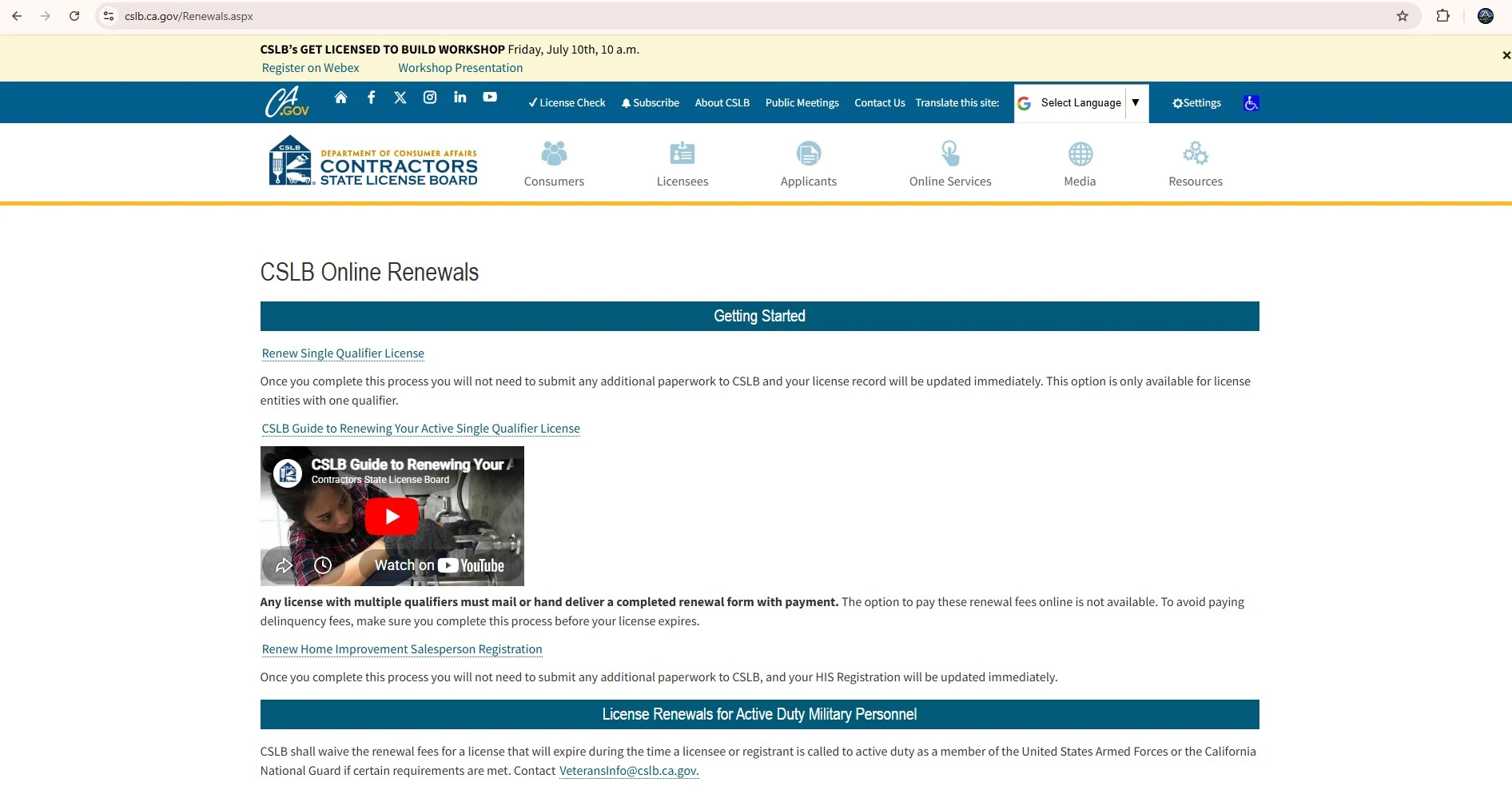
The official renewal page separates eligible single-qualifier online renewals from multiple-qualifier licenses that require a completed paper form.
Official CSLB renewal page preview
The screenshot below helps you recognize the official state renewal page. Complete the transaction only on a CSLB or CA.gov domain.
Renewal sequence
Check the public license record
Confirm the license number, expiration, active or inactive status, entity, classifications, qualifiers, bond, workers’ compensation and suspension information.
Count the qualifiers
A one-qualifier entity may qualify for online renewal. Multiple-qualifier licenses must use the paper route.
Identify the exact transaction
Choose active renewal, inactive renewal, reactivation or delinquent renewal. These are not interchangeable.
Resolve compliance items
Confirm bonds, corporate standing, qualifier status, workers’ compensation coverage or exemption and required classification codes.
Complete every certification and signature
Paper renewals require the correct entity representative and all listed qualifiers to sign as instructed.
Pay the current amount
Include the correct entity, active/inactive, timely/delinquent and C-10 amount plus any account-specific Industry Expert fees.
Verify the renewed record
Do not rely only on a receipt. Confirm the new expiration date and correct status in CSLB License Check.
Online Renewal, Paper Renewal or Reactivation?
| License situation | Correct route | Important limitation |
|---|---|---|
| One qualifier, remain active | Eligible license may renew online. | Active bond, qualifier and workers’ compensation requirements must be clear. |
| One qualifier, remain inactive | Eligible inactive renewal may be completed online. | Inactive status does not authorize bidding or contracting. |
| Multiple qualifiers | Mail or hand-deliver the completed renewal form and payment. | The online fee-payment route is unavailable. |
| Inactive becoming active | Use the separate reactivation application. | Normal online renewal cannot reactivate the license. |
| Expired less than five years | Use the duplicate or delinquent renewal route. | Do not perform licensed work while the record remains expired. |
| Expired more than five years | Apply through the original-license process. | The old license cannot be restored by normal renewal. |
| Business entity changed | Determine whether a new contractor license is required. | Renewal cannot convert one legal entity into another. |
Tool 1: CSLB Renewal Route Finder
Select the situation closest to your license.
Active Renewal vs Inactive Renewal
An active license normally renews for two years. An inactive license normally renews for four years but cannot be used to bid, contract or perform licensed construction work.
Active license
- Two-year renewal term.
- Active contractor bond required.
- Qualifying individual must remain properly associated.
- Workers’ compensation compliance or valid exemption required.
- Corporate or entity standing must remain acceptable.
Inactive license
- Four-year renewal term.
- Normal active bond and qualifier maintenance are not required.
- Workers’ compensation filing is not required for inactive status.
- No bidding, contracting or licensed construction work is allowed.
- A separate reactivation process is required to return to work.
CSLB Renewal Calendar: 90, 60, 45, 30 and 0 Days
| Timing | Best action | Why it matters |
|---|---|---|
| 90 days before expiration | Audit License Check, corporate standing, bonds, qualifier and workers’ comp records. | Entity, bond and insurance problems may require outside agencies to correct them. |
| About 60 days before | Watch for the CSLB-issued renewal application. | This is CSLB’s normal mailing window. |
| 45 days before | Order a duplicate or contact CSLB if the form has not arrived. | Waiting longer reduces correction and mailing time. |
| 30 days before | Finish signatures, classification codes and payment preparation. | Paper renewals can be returned for incomplete fields or signatures. |
| Expiration date | Online payment must be completed before midnight; paper applicants should already have submitted. | Late fees and possible unlicensed time begin after expiration. |
| After submission | Check License Check and the weekly processing-times page. | A receipt does not prove that the license was renewed. |
California Contractor License Renewal Fees
The amount depends on entity type, active or inactive status and whether the renewal is timely or delinquent. Active C-10 Electrical licenses pay an additional $20.
| Renewal transaction | Sole owner | Non-sole owner | Active C-10 total |
|---|---|---|---|
| Active timely | $450 | $700 | $470 sole / $720 non-sole |
| Inactive timely | $300 | $500 | Active C-10 surcharge does not apply |
| Active delinquent | $675 | $1,050 | $695 sole / $1,070 non-sole |
| Inactive delinquent | $450 | $750 | Active C-10 surcharge does not apply |
Tool 2: CSLB Renewal Fee Calculator
This planning tool excludes Industry Expert Recovery Fees and other license-specific charges.
Who Can Renew a CSLB License Online?
The online eService supports eligible active and inactive renewals when the license entity has only one qualifier.
Online-renewal conditions
- The entity must have one qualifier.
- The transaction can renew eligible active or inactive status.
- Inactive-to-active reactivation is not available.
- Multiple-qualifier classifications require paper renewal.
- The completed online transaction updates the license record in real time.
- No additional paper renewal is required after successful completion.
- Visa and Mastercard are accepted with a 2.99% processing charge.
- The session must be completed within 60 minutes.
- The portal is normally unavailable Sunday 8:00 p.m. through Monday 6:00 a.m.
Prepare before opening the timed session
- License number and expiration date.
- Current entity and status information.
- Workers’ compensation coverage, exemption or classification codes.
- Current address and email information.
- Payment card and billing information.
- Any account-specific enforcement fee shown by CSLB.
Paper Renewal for Multiple-Qualifier Licenses
CSLB does not permit online renewal-fee payment when classifications are attached to multiple qualifiers. The completed form and payment must be mailed or hand-delivered.
Paper-renewal checklist
- Use the renewal application issued or ordered for the correct license number.
- Complete the certification date, city, county and state.
- Provide the current business phone number and required email address.
- Provide a street address when the mailing address is a P.O. box.
- Enter the Federal ID number for a partnership where requested.
- Complete workers’ compensation recertification and class-code fields.
- Attach any bond, personnel or compliance documents identified by License Check.
- Include the correct check or money order payable to CSLB.
- Keep a complete copy and tracked-delivery evidence.
Who Must Sign a Paper CSLB Renewal?
Missing entity or qualifier signatures can cause the renewal to be returned and create expired-license time.
| License entity | Entity representative | Qualifier signatures |
|---|---|---|
| Sole owner | The owner signs. | All additional listed qualifiers sign where required. |
| Partnership | All general partners sign. | Every RME or qualifying partner signs. |
| Corporation | An officer listed on the renewal signs. | Every RME or RMO signs. |
| Limited liability company | A listed officer, member or manager signs. | Every responsible managing employee, officer, member or manager signs. |
| Joint venture | The qualifying individual of each entity signs. | Confirm every qualifier printed on the renewal. |
Workers’ Compensation Requirements for 2026 Renewal
An active contractor must have acceptable workers’ compensation coverage, self-insurance or a legally available exemption on file before active renewal can be completed.
Current no-employee exemption route
The current exemption form allows an eligible applicant or licensee to certify under penalty of perjury that no one is employed in a manner subject to California workers’ compensation law.
Do not use the exemption form when
- The license is inactive because inactive status does not require the form.
- The qualifier is a Responsible Managing Employee.
- The contractor has employees.
- The active license includes C-8 Concrete.
- The active license includes C-20 HVAC.
- The active license includes C-22 Asbestos Abatement.
- The active license includes C-39 Roofing.
- The active license includes C-61/D-49 Tree Service.
When an exempt contractor hires someone
The exemption stops being valid when the contractor employs someone subject to California workers’ compensation law. The required insurance certificate must be submitted to CSLB within the applicable 90-day period and coverage must be maintained continuously.
Universal coverage begins in 2028 under current law
The 2026 CSLB law book shows the broader workers’ compensation requirement becoming operative January 1, 2028. Older material stating that all active contractors needed coverage beginning in 2026 is outdated.
The March 2026 SB 291 report is a proposal—not the current renewal form
The report proposes a future evidence-based exemption process that could include narrower entity eligibility, attestations, business plans, filing fees and audits. Contractors should not treat those proposed criteria as already implemented unless CSLB publishes new operative instructions.
Workers’ Compensation Payroll Classification Codes
An active licensee with a workers’ compensation certificate must report the three classification codes associated with the highest estimated payroll on the policy.
| Policy situation | What to enter | What happens if omitted |
|---|---|---|
| Three or more codes | The three codes tied to the highest estimated payroll. | Renewal cannot be completed without the required codes. |
| Fewer than three codes | Every classification code on the policy. | Do not invent or duplicate a code to fill three fields. |
| Code includes a suffix | Enter the complete four-to-six-digit value supplied by the insurer. | A missing suffix may prevent a match. |
| Code is not found in WCIRB search | Use the code supplied by the insurance company or broker. | CSLB may display the insurer so the public can request the description. |
| Renewal rejected for missing codes | Supply the correct codes within the notice period. | The bulletin describes possible retroactive renewal when corrected within 30 days after notice. |
Contractor Bond, Qualifier Bond and Corporate Standing
Payment alone cannot produce an active license when a bond, qualifier or corporate-status problem remains unresolved.
Contractor bond
A $25,000 contractor bond must be on file before CSLB can issue, reactivate or actively renew a license. The business name and license number on the bond must match CSLB exactly.
Bond of Qualifying Individual
A separate $25,000 qualifier bond can be required for an RME and for an RMO who owns less than 10% of the corporation. Each qualifier on a multiple-qualifier license must satisfy the applicable bonding rule.
Corporate status and name
CSLB checks the Secretary of State record before renewing a corporate license. The corporation must be active, and its registered name and corporate number must match the CSLB record.
Changes that a renewal cannot repair
- Sole owner changing to a corporation, partnership or LLC.
- Partnership ownership changing in a way that creates a different licensed entity.
- Corporate registration number changing.
- Corporation becoming dissolved, merged or surrendered.
- Business name implying an unlicensed classification or different entity.
- Qualifier disassociation that requires a separate replacement process.
Expired and Delinquent California Contractor Licenses
When an acceptable renewal is not completed by expiration, delinquent fees apply and the public record may show expired.
Two different 90-day issues appear in CSLB guidance
CSLB describes statutory retroactive reinstatement when a completed renewal and proper fees are received within 90 days of expiration. Its general page also describes a written petition route requiring submission within 90 days and proof that the delay was outside the licensee’s control. Contact CSLB promptly instead of assuming retroactivity will apply automatically to every incomplete or late filing.
Expired less than five years
The license can generally use a delinquent renewal route if ownership has not changed and all current requirements are satisfied.
Expired more than five years
Normal renewal is unavailable. The former license holder must use the original contractor-license application process.
| Timing | Likely issue | Next action |
|---|---|---|
| Before expiration | Timely renewal fee applies. | Submit a complete renewal early. |
| After expiration | Delinquent fee and possible break in licensing time. | Stop licensed work and file the correct delinquent renewal. |
| Within 90 days | Potential statutory or petition-based retroactive treatment. | Contact CSLB immediately and retain all evidence. |
| Under five years | Delinquent renewal may remain available. | Order the official renewal for the existing entity. |
| Over five years | Renewal route is closed. | Apply as an original contractor-license applicant. |
How to Confirm CSLB Processed the Renewal
A receipt, canceled check or delivery confirmation proves payment or delivery—not successful renewal.
| Public status or message | Meaning | What to do |
|---|---|---|
| Renewal received but not processed | CSLB logged the renewal, but technician review is pending. | Compare the receipt date with the live processing-times page. |
| Expired | The record has not yet received a renewed expiration date. | Do not perform licensed work. |
| New expiration date | The renewal has been processed. | Confirm active/inactive status, classifications, bond and insurance details. |
| Renewed under suspension | The renewal term changed, but a suspension remains. | Clear the suspension before contracting. |
| Returned for correction | The renewal was not acceptable. | Correct every item and return it within the letter’s 90-day response period. |
When to call CSLB
Contact CSLB when payment has cleared but License Check shows neither a renewed status nor a received-pending message, or when the processing-times page has advanced beyond the date the completed renewal was received.
Common Reasons CSLB Returns a Renewal
Missing signatures
The required owner, partner, officer, member, manager or qualifier did not sign.
Workers’ comp incomplete
Coverage, exemption certification or class-code information is missing.
Wrong fee
The payment uses the wrong entity, status, delinquency or C-10 amount.
Entity changed
The existing license cannot legally continue under the new ownership structure.
Corporate mismatch
The Secretary of State name or registration status does not match CSLB.
Bond or qualifier problem
An active requirement remains canceled, suspended or incomplete.
Certification incomplete
The date, city, county, state or declaration was left blank.
Address incomplete
A P.O. box was supplied without the required business street address.
Wrong form
The applicant used an unofficial, outdated or incorrect transaction form.
Tool 3: Renewal Rejection-Risk Checker
Complete all six checks before submitting.
Does CSLB Require Continuing Education to Renew?
The standard CSLB contractor-license renewal instructions do not list universal continuing-education hours for every contractor classification.
Separate training or certification may still apply
- Asbestos or hazardous-substance certification.
- Cal/OSHA employee and jobsite safety training.
- Prevailing-wage, payroll and labor-compliance duties.
- Building-code and local permit updates.
- Home-improvement contract requirements.
- Training imposed by discipline, settlement or another agency.
Military Renewal Fee Waiver
CSLB may waive renewal fees for a license that expires while the licensee or registrant is called to active duty in the United States Armed Forces or California National Guard when program requirements are met.
Prepare these details
- Contractor license or registration number.
- License expiration date.
- Military branch or National Guard status.
- Active-duty orders and dates.
- Current mailing and email address.
- Questions about active, inactive or deployment-period status.
CSLB Renewal Phone, Email and Mailing Address
General renewal help
Have the license number, expiration date and exact issue ready.
Renewal email
Do not email card numbers, Social Security numbers or unnecessary private records.
Paper-renewal mailing
Contractors State License Board
P.O. Box 26000
Sacramento, CA 95826-0026
Sacramento headquarters
9821 Business Park Drive, Sacramento, CA 95827. CSLB currently accepts exact cash, check or money order at Sacramento headquarters; several regional offices are not accepting payments.
California Contractor License Renewal FAQs
How often does a California contractor license renew?
An active California contractor license normally renews every two years. An inactive contractor license normally renews every four years.
Can I renew my CSLB license online?
An eligible active or inactive license entity with one qualifier may use the online renewal eService. A license with multiple qualifiers must mail or hand-deliver the completed renewal form and payment.
How much is a timely active CSLB renewal?
The current timely active fee is $450 for a sole owner and $700 for a non-sole-owner entity. An active C-10 Electrical license pays an additional $20.
Can an inactive license be renewed online?
An eligible single-qualifier inactive license can be renewed online as inactive. The normal online-renewal portal cannot reactivate the license for contracting work.
What happens when a CSLB renewal is late?
A delinquent fee applies, and the license may show expired until an acceptable renewal is processed. Do not bid, contract or perform licensed work while the record shows expired.
How long can an expired California contractor license be renewed?
An expired license can generally be renewed within five years when ownership has not changed. After more than five years, the original contractor-license application process is required.
Does every contractor need workers’ compensation insurance in 2026?
No. An eligible no-employee licensee may still use the current exemption process. The exemption is unavailable for employees, an RME qualifier and specified classifications including C-8, C-20, C-22, C-39 and C-61/D-49. Broader universal coverage is scheduled for 2028 under current law.
Which workers’ compensation class codes are required?
An insured active licensee reports the three classification codes tied to the highest estimated payroll. When the policy has fewer than three codes, every listed code must be supplied.
Does CSLB require continuing education for every renewal?
The standard contractor-license renewal instructions do not list universal CE hours for every classification. Separate certification, safety, disciplinary or local training requirements may still apply.
How do I know CSLB processed my renewal?
Use official License Check and confirm the new expiration date and correct active or inactive status. A payment receipt or delivery confirmation alone does not prove successful renewal.
Renew Early and Verify the Public Record
Single-qualifier licensees: prepare compliance information and payment details before opening the timed online session.
Multiple-qualifier entities: obtain every signature, mail well before expiration and monitor processing times and License Check.