
Check the Contractor’s CSLB Record Before You Sign or Pay
A Contractors State License Board license check is the California step homeowners use before hiring a contractor, signing a home improvement contract, paying a deposit, or trusting a “licensed and bonded” claim.
The useful check is not just finding a number. You need to match the CSLB record with the legal business name, license status, classification, bond, workers’ compensation, complaint disclosure, HIS registration when relevant, and the local permit route for the job address.
Quick Answer: Use CSLB License Check, Then Match the Job Details
To check a California contractor, use the official CSLB license check and search by license number first. If you do not have the number, search by business name, personnel name, Home Improvement Salesperson registration number, or salesperson name. Then compare the record with the contract, payment name, job address, work classification, bond and workers’ compensation information.
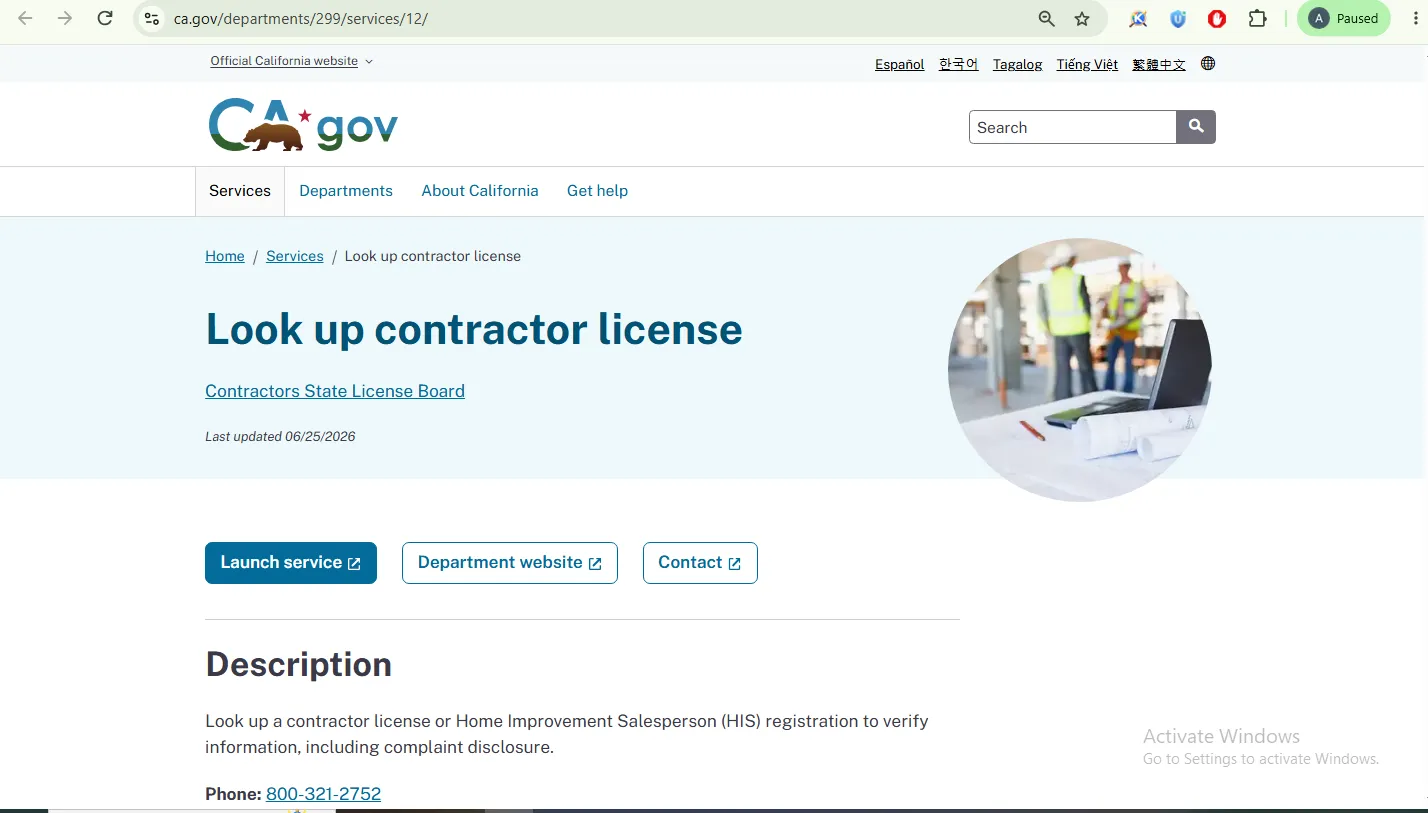
Official California CSLB Contractor License Check Screenshot
This screenshot belongs near the lookup instructions because it helps readers recognize the official California license-check page before they type a license number or business name.
Official CSLB Links for the Actual License Check
Use the links in this section for official action. This page explains how to read the California record, but CSLB’s live database controls the current license and HIS registration information.
Open the license check
If a direct license-check page fails to load, open CSLB Online Services and choose “License Check.” CSLB pages sometimes move between mirrors or reload through a secure service path.
Find hiring and complaint help
After checking the license, use CSLB’s consumer pages for hiring guidance, complaint routes, bond information, and current forms.
How to Search the CSLB License Check Page
The California lookup works best when you search narrowly first, then broaden carefully. Do not treat a similar business name as a match until the record lines up with the contract and payment name.
Start with the contractor license number
A California contractor license number is numeric and does not contain alphabetic characters. Enter the number from the pocket license, contract, bid, ad, vehicle, or contractor email exactly as shown.
Search by business name if needed
If no number is available, search the legal business name. CSLB suggests trying fewer letters if the name does not appear, and skipping opening words such as “The” or “A” at first.
Use personnel or HIS search when the name is confusing
CSLB also provides search paths for personnel names and Home Improvement Salesperson records. These are useful when a salesperson sells the job but the contractor business holds the license.
Open the exact record
Do not rely on a search-result row. Open the record and review the license status, entity type, classification, personnel, bond, workers’ compensation, complaint disclosure and license history information shown.
Recheck before signing or paying
License data can change. Reopen the CSLB record close to the date you sign, pay a deposit, approve a change order, or allow work to start.
What to Compare on a California CSLB Record
The point of a license check is to match the public record to the real job. A license can be real but still fail to match the person, company, classification or permit on your project.
| Record item | What to check | Why it matters |
|---|---|---|
| Business name | Compare the CSLB name with the estimate, contract, invoice, payment app, bank name and permit applicant. | A valid license number belonging to a different company does not protect your project. |
| License status | Look for active, inactive, expired, suspended, revoked, canceled or other status language. | A contractor generally needs an active and appropriate license before bidding or performing regulated work. |
| Classification | Review the A, B or C classification and any specialty class tied to the job. | The class must fit the project scope. A license is not a blank permission slip for every trade. |
| Personnel | Review listed qualifiers, officers, responsible managing employee or responsible managing officer where shown. | The qualifier is tied to the construction operations for the classification. |
| Bond | Look for contractor bond information and any qualifier bond issue where applicable. | California licensed contractors must maintain a contractor license bond, but a bond is not the same as insurance or a quality guarantee. |
| Workers’ compensation | Check whether CSLB displays workers’ compensation insurance, self-insurance or an exemption. | If someone is hurt on the property and coverage is missing, a homeowner can face serious financial risk. |
| Complaint disclosure | Review any public disclosure link or legal-action note shown by CSLB. | CSLB complaint disclosure is restricted by law, so the public page may not show every issue immediately. |
When California Requires a CSLB Contractor License
California’s current CSLB guidance says businesses or individuals who construct or alter a building, highway, road, parking facility, railroad, excavation or other structure must be licensed if the project requires a building permit, uses any additional workers, or the total cost of one or more contracts on the project is $1,000 or more, including labor and materials.
A license is commonly triggered when
- The project requires a building permit.
- The contractor uses additional workers.
- The total project cost is $1,000 or more, including labor and materials.
- The person is bidding, contracting, subcontracting or performing regulated construction work.
- The work is home improvement, specialty trade work, residential construction or commercial construction that falls under CSLB rules.
The small-job exemption is narrow
A contractor license is not necessary only when the project does not require a building permit, no employee labor is used, and the combined value of labor, materials and all other costs on one or more contracts is less than $1,000.
A larger project cannot be broken into smaller pieces to fit under the exemption.
CSLB License Classifications: A, B, C and Specialty Scope
California contractor licenses are organized by classification. The classification matters because a license can be active but still not cover the project you are hiring for.
Class A
General engineering contractor work generally covers fixed works requiring specialized engineering knowledge and skill. It is not the same as a general building license.
Class B
General building contractor work is tied to building structures. CSLB classification rules still include important limits, especially when specialty work dominates the project.
Class C
Specialty classifications cover specific trades or crafts. Electrical, plumbing, HVAC, roofing, swimming pool, concrete, painting and other work may require the correct C classification.
Bond, Workers’ Compensation and Insurance: What the License Check Does Not Prove
A California CSLB record can show useful bond and workers’ compensation information, but homeowners still need to understand the limits. A bond is not the same as liability insurance, and an active license is not a guarantee of quality.
| Item | California detail | What homeowners should do |
|---|---|---|
| Contractor license bond | Licensed California contractors are required to have a contractor license bond. CSLB currently references a $25,000 contractor bond. | Do not assume the bond covers your full project loss. Save contracts, payments and photos if a claim may be needed. |
| LLC bond | CSLB original-license materials state that LLC licenses require a $100,000 surety bond in addition to the contractor’s bond. | If hiring an LLC, review the CSLB record and written contract carefully. |
| Workers’ compensation | California employers must carry workers’ compensation insurance even with one employee. Active licensees must provide valid coverage, self-insurance, or a signed exemption when allowed. | Look at the license record and ask for current insurance proof before workers come to your property. |
| Mandatory workers’ comp classes | Active C-8, C-20, C-22, C-39 and C-61/D-49 contractors must carry workers’ compensation or valid self-insurance even if they have no employees. | Be extra cautious with concrete, HVAC, asbestos, roofing and tree-service projects. |
| General liability | CSLB consumer guidance says commercial general liability insurance is not required, but it covers damage to property. | Ask whether the contractor carries it and how property damage will be handled if not. |
Home Improvement Salesperson Registration Check
California’s CSLB lookup is not only for contractor licenses. It also checks Home Improvement Salesperson registration. That matters when a salesperson, canvasser or sales representative sells the home improvement contract but a separate licensed contractor is supposed to perform the work.
What to search
- HIS registration number if shown.
- Salesperson last name and first name.
- Contractor business tied to the salesperson.
- Current registration status and registration dates.
What not to assume
A salesperson registration is not the same as a contractor license. If a salesperson sells the job, still check the contractor license number, legal business name, classification, bond, workers’ compensation and contract signer.
Local California Permit Checks After the CSLB Search
A state license does not issue your project permit. California cities and counties handle building, electrical, plumbing, mechanical, grading, fire, planning and inspection records through local departments.
Los Angeles
Use LADBS records and permit services to check permits, inspection records and building documents for City of Los Angeles projects.
San Diego
City of San Diego Development Services provides permit search and project tracking tools for local development and building records.
San Francisco
San Francisco users should check the Department of Building Inspection permit and complaint tracking tools for property-specific permit history.
Sacramento
For Sacramento projects, use the city building permit service page or public permit portal to search permit history by property or permit information.
Complaints, Unlicensed Activity and CSLB Disclosure Limits
CSLB handles complaints against licensed and unlicensed contractors for possible violations of California Contractors License Law. A CSLB complaint can support investigation or discipline, but CSLB warns that an investigation is not a guaranteed restitution process.
| Problem | Where to start | What to save |
|---|---|---|
| Licensed contractor dispute | CSLB construction complaint route. | Contract, change orders, payment records, photos, messages, permit records and CSLB lookup result. |
| Unlicensed contractor | CSLB unlicensed contractor complaint or SWIFT referral for active work. | Ad, license claim, job address, vehicle photo, payment request, business card and contractor messages. |
| Illegal advertising | CSLB advertising complaint form. | Screenshot, printed ad, social profile, phone number, email and date seen. |
| Failure to pull permit | CSLB building permit violation referral and the local building department. | Permit search result, inspection notice, contract permit language and contractor response. |
| Money recovery | CSLB complaint may help, but court, bond claim, insurance claim or legal advice may be separate. | Damages, estimates, invoices, payment proof, demand letter and final judgment if one exists. |
California Contractors State License Board Contact Details
Use CSLB contact channels for licensing, application, complaint, disclosure, classification and official record questions. Do not send sensitive personal documents through ordinary email unless CSLB specifically instructs you to.
CSLB Headquarters
Useful CSLB email routes
Contractors State License Board License Check FAQs
Where do I check a California contractor license?
Use the official CSLB License Check. Search by contractor license number first, then use business name, personnel name, HIS registration number or salesperson name if needed.
What does CSLB stand for?
CSLB stands for Contractors State License Board, the California board that licenses and regulates contractors under California Contractors License Law.
Can I search a Home Improvement Salesperson registration?
Yes. The CSLB license check page also provides search options for Home Improvement Salesperson registration numbers and salesperson names.
Does a California contractor license number include letters?
No. CSLB says a California contractor license number does not contain alphabetic characters. Home Improvement Salesperson registration numbers include a numeric portion plus the letters SP.
When does California require a contractor license?
Current CSLB guidance says a license is required when the project requires a building permit, uses additional workers, or the total cost of one or more contracts on the project is $1,000 or more, including labor and materials.
Does an active CSLB license prove the contractor has general liability insurance?
No. CSLB consumer guidance says commercial general liability insurance is not required, although it can protect against property damage. Ask the contractor how property damage will be covered.
How much can a California contractor ask for as a down payment?
For a home improvement project, the down payment generally cannot be more than 10 percent of the contract price or $1,000, whichever is less, unless the contractor has a qualifying blanket performance and payment bond on file with CSLB.
Does a CSLB license replace a local building permit?
No. A CSLB license and a local permit are different. After checking the contractor license, contact the city or county building department for the job address.
Can CSLB complaints get my money back automatically?
No. CSLB investigates possible violations and may take disciplinary action, but it warns that an investigation does not guarantee restitution. Court, bond, insurance or legal routes may be separate.
Does ContractorsBoard.org verify California contractors?
No. ContractorsBoard.org is an independent guide. Use the official CSLB database and California agency pages for current license status, applications, renewals, complaints and regulatory decisions.
Final California License Check Before Hiring
Before you hire, match the CSLB license number, legal business name, classification, bond, workers’ compensation, HIS registration when relevant, written contract, payment name and local permit route.
The safest California contractor check is simple: official CSLB record first, written contract second, local permit third, payment last.